
Today, we have the distinct honour of speaking with Year 2014 Nobel Peace Laureate Kailash Satyarthi, a global leader whose lifelong work has transformed the fight against child labour, trafficking, and exploitation.
Mr. Satyarthi’s efforts have not only rescued thousands of children but have also shaped international discourse on child rights, influencing governments, global institutions, and civil society across the world. His advocacy reminds us that the protection of children is not merely a social responsibility, but a fundamental test of governance and democratic accountability.
At a time when parliaments worldwide are grappling with complex challenges—from inequality to migration and the evolving risks of digital exploitation—his voice offers both moral clarity and policy direction.
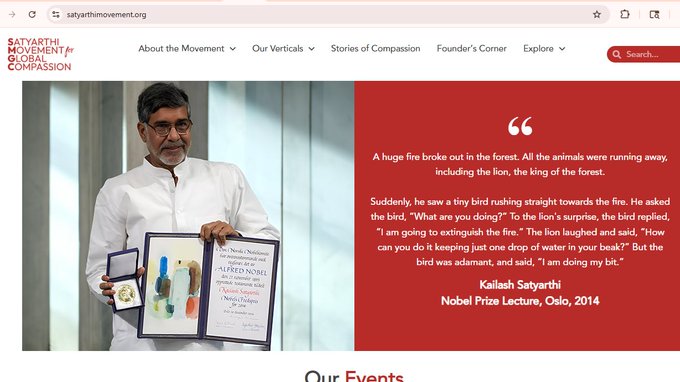
In this conversation, we will explore the role of legislators and governments in strengthening child protection systems, the urgency of global cooperation, and the concrete steps needed to eliminate other global problems like child labour. .
As the most original thoughts come in our mother tongue, we will conduct this interview in Hindi, his mother tongue, and the interview will be published in UN languages as possible.
Mr. Satyarthi, it is a privilege to have you with us. Welcome to The International Parliament Journal IPJ.
Let me begin by asking…

International Parliament Journal IPJ : Today, you are not only advocating against child labour but also for women empowerment, marginalised communities, sustainable development, climate action, ethical technology, and the SDGs. How successful has the global community been so far? Where are we falling short, and what should be the roadmap beyond 2030?
2014 Nobel Peace Laureate Kailash Satyarthi : We are living in a world that is not only interconnected but deeply interdependent. The challenges we face—whether related to children, women, environment, or peace—are all linked with one another. Therefore, their solutions cannot be fragmented or addressed in isolation. From the very beginning of my work, I have believed that the condition of a child reflects the past, present, and future of our civilization. If a child is enslaved, exploited, or deprived of education and dignity, it is not just an isolated failure—it is a collective failure of our systems, values, and governance. If a child is a slave or a girl is mistreated, it reflects a failure in our history and our present system. Permanent change is impossible if development benefits do not reach the “last person”—the child and the family at the edges of society.
There is no doubt that the world has made progress. Democracies have expanded, institutions have been built, and there is greater awareness about rights and freedoms. However, alongside this progress, we are witnessing a deep moral crisis. The absence of moral leadership is one of the most serious challenges today. Nations are increasingly driven by narrow self-interest, often at the expense of global good.
If we look at global priorities, the contradiction becomes even clearer. The world spends trillions of dollars annually, specifically USD 2.7 Trillion, on military expenditure, while relatively modest resources could ensure that no child goes hungry or remains out of school. This imbalance reflects not a lack of capacity, but a lack of intent and moral commitment.
#labouraday #mayday #workersday #internationallabourday https://t.co/pHKxr7zUlU
— The International Parliament Journal (IPJ) (@ipj_parliaments) April 30, 2026
As far as the Sustainable Development Goals are concerned, it is becoming increasingly evident that we will not fully achieve them by 2030. This is not because the goals are unrealistic, but because we have not acted with the honesty, urgency, and collective responsibility required. The Millennium Development Goals were not fully achieved, and the Sustainable Development Goals will also fall short. By 2030, only fragments will be met. Beyond 2030, the world must embrace honesty and courage. We must prioritise children, women, and marginalised communities over political power and military spending. The roadmap must be rooted in moral responsibility, not just technical targets.
Looking beyond 2030, the roadmap must involve a fundamental shift in how we think and act. We must move from fragmented approaches to integrated solutions. We must bridge the persistent gap between policy and implementation. Most importantly, we need to move beyond the language of ethics and adopt what I call compassionate leadership—a form of leadership that treats the suffering of others as one’s own responsibility and acts with urgency and accountability to address it.

International Parliament Journal IPJ : ‘IPJ Global Report: Youth Voices in Parliaments 2025 (Mapping the Rise, Gaps & Future of Young Lawmakers Worldwide)’ highlights that only 2.8% of Members of Parliament globally are under the age of 30, and in a majority of upper houses, about 76%, youth representation is nearly absent. What must be done to improve youth participation in parliaments worldwide?
2014 Nobel Peace Laureate Kailash Satyarthi : The problem lies in a “rotten mindset” toward youth. Many leaders internalise the “power of the chair” and refuse to share it. Society and politics often question whether a 25-year-old can run a country, yet corporations pay millions for young talent in AI and coding. Power does not come from occupying a chair; it comes from controlling it. Too many older leaders cling to power and let it control them, which blocks renewal. Political systems exclude young people not because they lack ideas or energy, but because these systems protect the status quo. We must recognise that any country that ignores its youth traps itself in a mental and social cage.
Youth representation does not depend on capability; it depends on mindset and power structures. Across the world, those in power often refuse to share it. Power rarely stays external; it settles within individuals. Once leaders internalise power, they struggle to create space for others, especially young people.
Society also carries a deep bias that young people lack maturity or experience for leadership. This belief is flawed. In technology, innovation, and entrepreneurship, young people already drive major transformations at early ages. Yet politics ignores this same energy and potential.
Political systems add another layer to the problem. Parties fail to create clear pathways for young people to enter and grow into leadership roles. Instead, they use youth as supporters or mobilisers rather than decision-makers.
To fix this, leaders must actively reform political institutions and cultures. Political parties should democratise internally and create real opportunities for young leaders. Society must also accept that age alone does not define leadership. Most importantly, current leaders must choose to share power—not symbolically, but in practice.
Societies should lower barriers for young candidates, reform political parties to welcome youth voices, and build clear pathways from local councils to national assemblies. Young people bring energy, innovation, and urgency that democracy needs. Without their participation, parliaments will stagnate, and democracy will lose its relevance.

International Parliament Journal IPJ : According to “IPJ Global Report: Women in Parliaments Around the World in 2025″, women’s representation in parliaments has reached 27% in 2025, up from 11% in 1995, but the rate of increase is very slow. As per Inter-Parliamentary Union (IPU), by 2063, the world may see proper women representation in Parliaments around the world. What needs to be done to accelerate women’s participation in democratic institutions?
2014 Nobel Peace Laureate Kailash Satyarthi : Democracy cannot be complete without women’s equal participation. Progress has been made, but the pace is painfully slow. Women face structural barriers—financial, cultural, and institutional—that prevent them from entering politics.
The progress we have seen in women’s representation is important, but it is far from sufficient. At the current pace, achieving true equality will take several decades, which is unacceptable. The fundamental issue lies not only in political systems but in the social conditioning that begins at birth.
From childhood, girls are often treated differently in terms of education, opportunities, and expectations. These inequalities accumulate over the time and eventually reflect in political and economic participation. Therefore, the solution must begin much earlier than the stage of elections or parliamentary representation.
It is also important to understand that empowerment cannot be given as a favour. Rights are not granted; they are claimed. Women must be enabled to claim their rightful space in society and politics through education, economic independence, and leadership development. Men will not simply “give” power; women will have to take it through their own capacity. This requires a shift in global social mentality, which still often views women as weak or suited only for domestic roles. True progress starts with a girl’s education and values from childhood, empowering her to win elections on her own merit rather than just seeking “protection”.
At the same time, political systems must be reformed to remove barriers that hinder women’s participation. This includes addressing biases, ensuring fair access to resources, and creating an environment where women can participate without fear or discrimination. We must challenge patriarchal norms within political parties, ensure financial support for women candidates, and enforce stronger gender quotas.
But beyond numbers, women must be empowered to shape policy, not just occupy seats. When women participate meaningfully, democracy becomes more inclusive, more compassionate, and more just. True democracy cannot exist unless women are equal participants in decision-making at every level—from local governance to national parliaments.

International Parliament Journal IPJ : The IPU has elected a new Secretary-General after 12 years. Four of the five candidates were women. What are your expectations from the next leader of this important global institution?
2014 Nobel Peace Laureate Kailash Satyarthi : The Inter-Parliamentary Union is the supreme global parliamentary institution. Its leadership must rise to the challenge of our times.The Inter-Parliamentary Union plays a crucial role in shaping global parliamentary cooperation, and its leadership carries significant responsibility.
I expect the next Secretary-General to strengthen cooperation among parliaments worldwide, to prioritise child rights, women’s empowerment, and climate justice, and to ensure accountability in achieving the SDGs. Above all, the IPU must provide moral leadership where governments fail. The next Secretary-General must demonstrate a strong commitment to peacebuilding and dialogue, especially in a world increasingly affected by conflict and division.
Having worked closely with the current Secretary-General, Martin Chungong, I consider him an ideal leader who sought stability in tough situations. The successor must be both aggressive and diplomatic in establishing peace. They must have the courage to speak for the most excluded groups—children, tribals, and minorities.
If the empowerment and voice of these groups are not strong, the Parliament itself will not be strong. Equally important is the promotion of women’s leadership and the inclusion of marginalised communities. A strong parliamentary system cannot exist if large sections of society remain excluded or unheard.
Another critical expectation is the ability to identify and connect parliamentarians across countries who are genuinely committed to solving real problems. Across the world, there are individuals within political systems who are sincere, ethical, and dedicated to public service. However, they often remain isolated within their own national contexts. Creating networks among such leaders can significantly enhance global cooperation and impact. The IPU must move beyond being a platform for dialogue and become a catalyst for meaningful action and collaboration.

International Parliament Journal IPJ : In many parts of the world, democracy is under strain due to war, civil unrest, and social conflict. What steps should governments and global organisations take to strengthen democracy?
2014 Nobel Peace Laureate Kailash Satyarthi : Many people reduce democracy to the process of elections, but its true essence lies in justice, accountability, and the protection of human dignity. Today, politics in many countries has become increasingly transactional. Leaders treat people as vote banks defined by identity—religion, caste, or ethnicity—rather than as human beings with rights and aspirations.
This approach weakens the very foundation of democracy. Political leaders often sideline real issues such as poverty, education, child protection, and social justice to chase short-term gains.
To strengthen democracy, leaders must shift their focus from identity-based politics to human-centric governance. Governments and political leaders should prioritise the needs of the most vulnerable sections of society. At the same time, parliamentarians must collaborate more actively across countries, especially on issues that cross national boundaries.
We must reimagine democracy as a system that not only represents people but also improves their lives.
Today’s international security system lacks democratic balance; powerful nations often use veto power to drive aggression and escalation. We need “Compassionate Leadership”—the ability to feel another person’s suffering as one’s own. If parliamentarians from warring nations viewed every child as “ours” instead of labeling them by religion or identity, they could prevent many conflicts.
Democracy cannot survive on rhetoric alone; it requires peace, justice, and inclusion. Governments and global organisations should prioritise peacebuilding over military spending. They must protect civilians, especially children, in conflict zones. They should also treat education and social justice as the foundation of democracy.
Parliaments need to engage in continuous dialogue, share best practices, and hold each other accountable. Democracy is not a gift; it is a responsibility. If we fail to protect the most vulnerable, violence and inequality will weaken democracy itself.

International Parliament Journal IPJ : You have been a strong advocate for the ethical use of new-age technology. What steps are needed to ensure that technology is not misused, especially against vulnerable communities?
2014 Nobel Peace Laureate Kailash Satyarthi : I have increasingly moved away from the term “ethical AI” and instead emphasise the idea of “compassionate AI.” The reason is simple—ethics and laws are created by human beings, and they often reflect limitations, biases, and inconsistencies. Artificial intelligence, on the other hand, is evolving at a pace and scale that can surpass human control.
Therefore, relying solely on regulations or ethical guidelines may not be sufficient. The real solution lies in the mindset of those who design, develop, and deploy these technologies.
Compassion, as I define it, is not merely a feeling of kindness or sympathy. It is a powerful force that arises when we perceive the suffering of others as our own and feel a deep sense of responsibility to address it. If this sense of compassion is embedded in every stage of technological development—from data collection to algorithm design to deployment—then technology can truly serve humanity.
Without this, there is a real risk that technology could amplify existing inequalities and create new forms of exploitation, particularly for children, women, and other vulnerable groups.
Technology is a double-edged sword. It can empower, but it can also exploit. The ethical use of technology requires global regulations, corporate accountability, and public awareness. Governments must legislate against misuse, corporations must safeguard rights, and citizens must be educated about digital safety.
Technology must be a tool for empowerment, not oppression. Just as we built a global movement against child labour, we must now build a global movement for ethical technology.
International Parliament Journal IPJ : Climate change continues to disproportionately affect the poorest and most vulnerable communities. What should be the global policy response to this crisis?
2014 Nobel Peace Laureate Kailash Satyarthi : Many people describe climate change as a global crisis, but I see it fundamentally as an issue of injustice. Those who contribute the least to carbon emissions suffer the most from its consequences. This imbalance does not happen by chance; systemic inequalities in how we produce, consume, and distribute resources create it.
Although governments and institutions have introduced many policies and international agreements on climate change, they often fail to implement them effectively. This failure creates a significant gap between promises and actual outcomes.
We must place justice at the core of any meaningful response to climate change. Governments should support communities facing displacement due to environmental changes, ensure fair transitions for workers affected by the shift to green energy, and hold countries accountable for their emissions.
At a deeper level, we must also change our values. We need to move from excessive consumption to sustainability and from exploitation to respect for nature. Without this transformation, policies alone cannot solve the problem.
Climate change goes beyond an environmental issue; it represents a moral challenge. The poorest communities suffer the most, even though they contribute the least. Policymakers must integrate climate action with poverty reduction. Parliaments should pass binding commitments, mobilise global funds for vulnerable communities, and place climate justice at the heart of democracy.
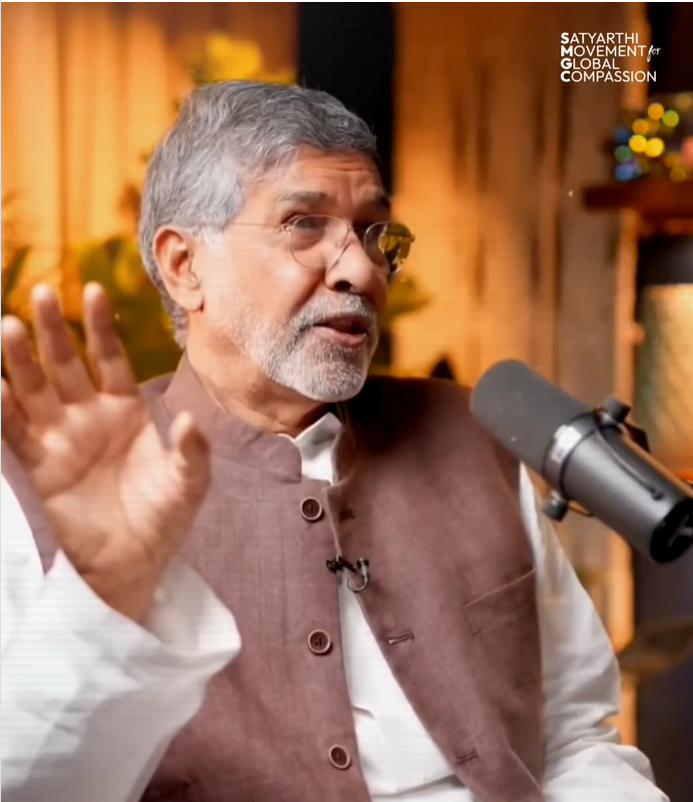
International Parliament Journal IPJ : There is limited dialogue and cooperation between parliaments globally. International Parliament Journal (IPJ)’s effort to connect 193 parliaments and 46,000 MPs revealed weak inter-parliamentary dialogue. What will it take to strengthen global parliamentary cooperation? How can leaders improve the exchange of best practices? And ultimately, how do we bridge this gap?
2014 Nobel Peace Laureate Kailash Satyarthi : The lack of meaningful dialogue between parliaments poses a serious concern, especially in an era where global challenges demand collective solutions. Although regional and international platforms exist, they often fail to deliver strong impact.
To address this gap, we must deliberately strengthen global parliamentary cooperation. Leaders should create more opportunities for direct engagement among parliamentarians, actively share best practices, and build trust across political and national boundaries.
More importantly, parliamentarians need to shift their perspective. They must see themselves not only as representatives of their own countries but also as stakeholders in a shared global future. When leaders commit to solving real problems instead of pursuing narrow interests, they enable meaningful collaboration.
Many regional parliamentary organisations have not delivered expected results. Only the European Parliament shows relative success. To strengthen cooperation, leaders must build digital platforms for continuous dialogue, organise joint sessions on global issues, and promote the exchange of best practices across parliaments. Without dialogue, democracy fragments; with dialogue, it becomes a global force for justice.
The connection between people and power should not remain limited to election day. If the Inter-Parliamentary Union strengthens coordination, parliamentarians can rise above party lines and act collectively. We must identify and connect those MPs who actively work on real solutions, rather than those who only deliver speeches.
Today, elections form the primary link between people and power. By strengthening coordination through the Inter-Parliamentary Union, we can connect the few thousand parliamentarians who genuinely drive social solutions instead of rhetoric. Leaders must foster collaboration based on development, knowledge, and shared technology.

The Nobel Prize medal
International Parliament Journal IPJ : Finally, what new initiatives and directions can we expect from you and your organisations in the coming years?
2014 Nobel Peace Laureate Kailash Satyarthi : The Nobel Prize opened doors, but the mission remains the same: freedom, dignity, and justice for every child. We continue to expand movements against child labour and trafficking, while building alliances for education, women’s empowerment, and climate justice. The struggle is far from over, but the vision is clear—a world where no child is enslaved, no woman is silenced, and no community is left behind.
My work continues to focus on building a global movement rooted in compassion. We are working to inspire and empower individuals—especially young people—to become leaders who are not afraid to ask difficult questions and take responsibility for finding solutions.
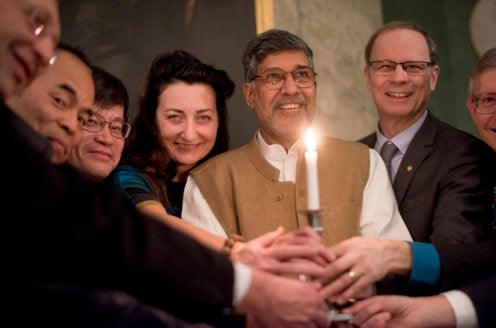
I believe that a person who has the courage to question and the commitment to act can never become irrelevant or outdated. Age is not defined by years, but by one’s willingness to engage with the challenges of the world.
Going forward, our efforts will continue to expand in areas that connect child rights, education, justice, and global cooperation, with compassion as the guiding principle.
We are focusing on Global Compassion. A person who has the courage to raise questions and find solutions is never old. We will continue to bridge the gap between policy and practice, ensuring that moral accountability and a sense of urgency drive global leadership.
Our “Satyarthi Movement for Global Compassion” will continue to challenge the gap between policy and practice. A person who has the courage to raise questions and find solutions is never old. We will continue to advocate for moral accountability and a sense of urgency to solve the world’s most pressing problems.
International Parliament Journal IPJ : Thank you, Mr. Satyarthi, for sharing such profound insights with us. It is always enlightening to engage in conversations that challenge conventional thinking and inspire meaningful action.
2014 Nobel Peace Laureate Kailash Satyarthi : Thank you.

Satyarthi Movement for Global Compassion