The year 2025 marks a pivotal moment for gender equality in global governance. Recent data from the Inter-Parliamentary Union (IPU) and UN Women highlights both steady gains and persistent hurdles. Today, women hold 27.2% of parliamentary seats globally. This figure reflects a significant climb from just 11.3% in 1995. However, progress has slowed in the last year, growing by only 0.3 percentage points. However, growth slowed, with only a 0.3 percentage point increase in 2024, the weakest since 2017. Inter-Parliamentary Union Women still remain underrepresented in key leadership roles. Fewer than one in four national parliamentary Speakers is female. UNSD
Global Leadership Milestones
- 25 countries had women serving as Heads of State or Government in 2025.
- Women held 22.9% of cabinet positions, often leading portfolios on human rights, gender equality, and social protection.
- Countries like Nicaragua, Finland, and Iceland achieved over 60% women in cabinet roles.

Regional Highlights
- Australia recorded historic gains with equal gender representation in cabinet and a record number of women entering parliament.
- Europe showed strong progress, with nations like Spain, Iceland, and the UK crossing the 50% threshold in cabinet representation.
Africa and Latin America saw steady increases, with Ethiopia, Mexico, and South Africa nearing parity.
Top Performers: Countries with Higher Female Representation
Some countries have achieved or surpassed gender parity:
- Rwanda: Around 64% women in parliament.
- Cuba: Over 55%.
- Nicaragua: About 55%.
- Mexico, Andorra, United Arab Emirates: About 50%. Inter-Parliamentary Union+1
These nations show that policy, quotas, and electoral systems can boost women’s political influence.
According to the latest Global Gender Gap and IPU data, women serve as Speakers in about one-third of parliamentary chambers worldwide, and women’s leadership in committee chairs is rising but uneven. World Economic Forum
The IPU’s 2025 push for gender parity highlighted more women being elected to chamber leadership roles at events and summits throughout the year. ipu.org
The year 2025 saw a record 29 countries led by women as Heads of State or Government. Additionally, women now preside over 23.7% of the world’s parliamentary chambers.
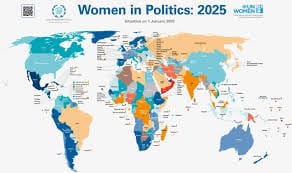
Global Distribution of Leadership
| Region | Women Speakers (%) | Women MPs (%) |
| Americas | 33.3% | 35.4% |
| Europe | 30.4% | 31.8% |
| Sub-Saharan Africa | 22.0% | 27.1% |
| Asia | 14.5% | 22.1% |
| Pacific | 12.0% | 23.2% |
| MENA | 0.0% | 16.7% |
Regional Highlights
- Africa: Ethiopia and South Africa saw women parliamentarians rise to deputy speaker and cabinet leadership roles.
- Latin America: Mexico and Colombia achieved near-parity in parliament and cabinet, with women leading justice and equality ministries.
- Europe: Spain, Iceland, and the UK crossed the 50% threshold in cabinet representation.
- Asia-Pacific: Australia recorded historic gains with equal gender representation in cabinet.
Regional Differences: Where Women Lead or Lag
The Americas and Europe show stronger female participation in parliaments:
- Americas: Around 34.5% women MPs.
- Europe: About 31.8% women MPs.
- Middle East & North Africa: Lowest at 16.7%. Inter-Parliamentary Union
Some countries outshine global averages. In the EU, more than one in three MPs is female. European Commission
Leadership Roles: Still Male-Dominated
Women remain a minority in leadership roles. Fewer than 24% of Speaker positions are held by women. Committee leadership in foreign affairs, defense, and finance also shows gender gaps. UNSD
Globally, men outnumber women by more than three to one in decision-making positions. Inter-Parliamentary Union
Challenges: Slow Pace and Barriers
Experts warn that the pace of change is too slow to reach parity soon. Gender quotas help, but structural barriers remain. Inter-Parliamentary Union
Women also face harassment and discrimination in politics, which can deter candidates from entering or staying in office. (Regional reports highlight this issue especially in the Asia-Pacific.) The Guardian
Local Insights: Country Progress Stories
- Australia: The 2025 federal election saw a record number of women elected. News.com.au
- Japan: Senate elections in 2025 brought more women into office, though overall representation remains modest. Le Monde.fr
Such cases show how elections can influence women’s representation.
Outlook: What’s Needed for Parity
Experts stress that political will, gender quotas, and inclusive systems are key. Without stronger measures, gender parity may remain decades away. Inter-Parliamentary Union
Women’s voices matter. They influence policy and represent diverse perspectives. Yet, more work is needed to ensure equal participation in lawmaking.
Women’s presence in parliaments worldwide has grown. But progress is uneven. Some nations lead. Others lag. Quotas and fair systems can help. But gender parity is still not within easy reach in 2025.
Leaders in Gender Parity
Six nations now lead the world with 50% or more women in their lower or single chambers. Rwanda remains the global frontrunner. Women comprise 63.8% of its parliament. Other leaders include:
- Cuba: 55.7%
- Nicaragua: 55.0%
- Mexico: 50.0%
- Andorra: 50.0%
- United Arab Emirates: 50.0%
These countries demonstrate that gender parity is achievable. Most of these leaders utilize legislated gender quotas to ensure balance.
Cabinet Leadership (High Representation Countries)
- Nicaragua, Finland, Iceland, Liechtenstein – Women held 60%+ of cabinet positions as of January 2025.
- Spain, United Kingdom, Chile, Andorra, Estonia – Achieved 50% women ministers, many in social protection, equality, and justice portfolios.
- Australia, Sweden, Colombia, Norway – Women held nearly half of cabinet posts, with several leading finance and defence portfolios.

Women Parliamentarians in Leadership Positions — 2025 (Global Overview)
(Presidents, Prime Ministers, Speakers, Deputy Speakers & Parliamentary Organization Leaders)
| No. | Name | Country / Organization | Position (2025) | Leadership Level | Historic / Strategic Significance |
| 1 | Sanae Takaichi | Japan | Prime Minister | Executive (Parliament-linked) | First woman Prime Minister of Japan; G7 breakthrough |
| 2 | Netumbo Nandi-Ndaitwah | Namibia | President | Executive | First woman President of Namibia |
| 3 | Jennifer Geerlings-Simons | Suriname | President | Executive | First woman President; former Speaker |
| 4 | Yulia Svyrydenko | Ukraine | Prime Minister | Executive | Leads post-conflict reconstruction |
| 5 | Brigitte Haas | Liechtenstein | Prime Minister | Executive | Strengthens female leadership in European microstates |
| 6 | Sushila Karki | Nepal | Prime Minister | Executive | Transition from judiciary to executive leadership |
| 7 | Emma Reynolds | United Kingdom | Economic Secretary to the Treasury | Parliamentary Executive | Oversees “Women in the Economy” agenda |
| 8 | Saara Kuugongelwa-Amadhila | Namibia | Speaker, National Assembly | Parliamentary | First woman Speaker in Namibia |
| 9 | Nelly Butete Kashumba Mutti | Zambia / IPU | Speaker & IPU Vice-President | Parliamentary / Global | Influential voice in global parliamentary diplomacy |
| 10 | Azarel Ernesta | Seychelles | Speaker, National Assembly | Parliamentary | First female Speaker in Seychelles |
| 11 | Mary Thom Navicha | Malawi | Leader of the Opposition | Parliamentary | Rare female opposition leader |
| 12 | Mary Maulidi Khembo | Malawi | Chair, Women’s Parliamentary Caucus | Parliamentary Committee | Strengthened women-led caucus governance |
| 13 | Mutani Tambala | Malawi | Chair, Education Committee | Parliamentary Committee | Women’s leadership in sectoral oversight |
| 14 | Lucia Witbooi | Namibia | Vice President | Executive | Part of rare all-female executive leadership |
| 15 | Women Speakers (Collective) | Inter-Parliamentary Union | 15th Summit of Women Speakers | Global Parliamentary | Drafted “Next Chapter for Gender Equality” road map |

Breaking the Glass Ceiling: Key Women Leaders of 2025
The year 2025 has seen a remarkable surge in women securing the highest offices in governance. From historic “firsts” in Asia to established parity in the Americas, these leaders are redefining the global political landscape.
1. Sanae Takaichi – Prime Minister, Japan
In a historic shift for Japanese politics, Sanae Takaichi was elected as the nation’s first female Prime Minister in October 2025. Her victory breaks one of the most enduring political barriers in the G7. Takaichi now helms a $4 trillion economy, focusing on economic resilience and national security.
2. Netumbo Nandi-Ndaitwah – President, Namibia
Namibia made history in March 2025 by swearing in Netumbo Nandi-Ndaitwah as its first female President. A veteran diplomat and former Deputy Prime Minister, she has been a vocal advocate for gender-corrective mechanisms in African parliaments. Her leadership marks a new chapter for the SADC region.
3. Jennifer Geerlings-Simons – President, Suriname
In July 2025, Suriname elected Jennifer Geerlings-Simons as its first woman President. A physician by training and a seasoned former Speaker of the National Assembly, she brings deep parliamentary expertise to the executive branch. Her focus remains on managing the nation’s burgeoning energy sector.
4. Yulia Svyrydenko – Prime Minister, Ukraine
Stepping into a vital role during a time of reconstruction, Yulia Svyrydenko was appointed Prime Minister in July 2025. Previously serving as the First Deputy Prime Minister, she is now tasked with navigating economic recovery and strengthening Ukraine’s institutional ties with Europe.
5. Brigitte Haas – Prime Minister, Liechtenstein
In April 2025, Brigitte Haas took office as the Prime Minister of Liechtenstein. Her appointment underscores the growing trend of female leadership within European microstates, following the parity achieved in neighboring Andorra.
6. Emma Reynolds – Economic Secretary to the Treasury, UK
Promoted in January 2025, Emma Reynolds now holds a key “hard” portfolio within the UK Treasury. She is specifically responsible for the “Women in the Economy” agenda, bridging the gap between parliamentary policy and financial sector reform.
7. Sushila Karki – Prime Minister, Nepal
In September 2025, Sushila Karki, formerly the first female Chief Justice of Nepal, was elected as Prime Minister. Her transition from the judiciary to the executive highlights a significant shift in Nepal’s democratic evolution.
Notable Parliamentary Milestones
- Namibia’s Executive Duo: Alongside President Nandi-Ndaitwah, Lucia Witbooi was sworn in as Vice President, creating a rare all-female executive team.
- The 15th Summit of Women Speakers: In July 2025, women Speakers from around the world gathered in Geneva to draft the “Next Chapter for Gender Equality,” a roadmap for parliamentary reform.
1. Saara Kuugongelwa-Amadhila — Speaker, National Assembly of Namibia
- Elected as Speaker of the Namibian Parliament in March 2025.
• First woman to lead Namibia’s legislature. Wikipedia
2. Nelly Butete Kashumba Mutti — Speaker & IPU Vice-President
- Serves as Speaker of Zambia’s National Assembly.
• In 2025 she was elected Vice President of the Inter-Parliamentary Union (IPU). Wikipedia+1
3. Azarel Ernesta — Speaker, National Assembly of Seychelles
- Elected as first female Speaker of the Seychelles Parliament in October 2025.
• Historic milestone in regional gender-balanced parliamentary leadership. cpahq.org
4. Mary Maulidi Khembo — Chair, Malawi Parliamentary Women’s Caucus
- Elected as chair of the Malawi Parliamentary Women’s Caucus in 2025 following national polls.
• Represents rising influence of women MPs in committee leadership. Wikipedia
5. Mary Thom Navicha — Leader of the Opposition (Malawi)
- Re-elected MP and Leader of the Opposition in Malawi’s Parliament.
• A key female voice in parliamentary opposition leadership for 2025. Wikipedia
6. Mutani Tambala — Chair, Parliamentary Committee on Education (Malawi)
- Appointed chair of the Education, Science and Technology Committee in Malawi in late 2025.
• Represents women in high committee leadership. Wikipedia
Heads of State & Government (Newly Elected/Incumbent 2025)
These women hold the highest executive authority in their respective nations as of 2025:
- Sanae Takaichi (Japan): Prime Minister (Elected Oct 2025) – First female PM in Japan’s history.
- Netumbo Nandi-Ndaitwah (Namibia): President (Sworn in March 2025) – First female President of Namibia.
- Jennifer Geerlings-Simons (Suriname): President (Elected July 2025) – First female President of Suriname
- Claudia Sheinbaum (Mexico): President (Incumbent) – First female President of Mexico
- Gordana Siljanovska-Davkova (North Macedonia): President (Incumbent) – First female President of the country.
- Yulia Svyrydenko (Ukraine): Prime Minister (Appointed July 2025).
- Judith Suminwa Tuluka (DRC): Prime Minister (Incumbent) – First female PM of the Democratic Republic of the Congo.
- Brigitte Haas (Liechtenstein): Prime Minister (Took office April 2025).
- Giorgia Meloni (Italy): President of the Council of Ministers (Incumbent).
- Mette Frederiksen (Denmark): Prime Minister (Incumbent).
- Paetongtarn Shinawatra (Thailand): Prime Minister (Incumbent).
- Draupadi Murmu (India): President (Incumbent)
- Dina Boluarte (Peru): President (Incumbent).
Speakers of Parliament (Presidents of Chambers)
As of late 2025, 64 women serve as Speakers of National Parliaments. Key notable leaders include:
- Maja Riniker (Switzerland): President of the National Council (and President of the 15th Summit of Women Speakers).
- Roberta Metsola (European Union): President of the European Parliament
- Bärbel Bas (Germany): President of the Bundestag.
- Yaël Braun-Pivet (France): President of the National Assembly.
- Lanein Blanchette (St. Kitts & Nevis): Speaker of the National Assembly.
- Alvina Reynolds (St. Lucia): President of the Senate.
- Rochelle Forde (St. Vincent & the Grenadines): Speaker of the House of Assembly.
- Tulia Ackson (Tanzania): Speaker of the National Assembly (and current President of the Inter-Parliamentary Union).
- Daggubati Purandeshwari (India): Chairperson of the Parliamentary Committee on Empowerment of Women
International Parliamentary Organizations
Women holding constitutional leadership within global and regional parliamentary bodies:
- Tulia Ackson: President of the Inter-Parliamentary Union (IPU).
- Ursula von der Leyen: President of the European Commission.
- Christine Lagarde: President of the European Central Bank.
- Tatiana Valovaya: Director-General of the United Nations Office at Geneva (Active in the 2025 Women Speakers Summit).
Key Legislative & Deputy Roles
A significant 32.6% of Deputy Speaker positions globally are now held by women. Notable 2025 appointments include:
- Atishi Marlena (India): Leader of the Opposition, Delhi Legislative Assembly (First woman in this role)
- Rekha Gupta (India): Chief Minister of Delhi (Assumed office Feb 2025).
- Lucia Witbooi (Namibia): Vice President (Appointed March 2025).
- Emma Reynolds (UK): Economic Secretary to the Treasury (Key parliamentary financial leadership).

Women Parliamentarians in Key Positions – 2025
Heads of State and Government
- Kaja Kallas (Estonia) – Prime Minister, re-elected in 2025, continuing her leadership in European politics.
- Mette Frederiksen (Denmark) – Prime Minister, strengthened her parliamentary majority in 2025.
- Sanna Marin (Finland) – Former PM, succeeded by another woman-led cabinet maintaining parity.
- Sheikh Hasina (Bangladesh) – Re-elected as Prime Minister, one of the longest-serving women leaders globally.
- Mia Mottley (Barbados) – Prime Minister, continued her leadership role in the Caribbean.
Parliamentary Speakers and Presidents
- Roberta Metsola (Malta) – President of the European Parliament, continued in 2025 as a key voice for EU democracy.
- Merav Michaeli (Israel) – Elected as Speaker of the Knesset in 2025, a breakthrough for women in Israeli politics.
- Eliane Tillieux (Belgium) – Speaker of the Chamber of Representatives, reaffirmed in 2025.
- Adriana Salvatierra (Bolivia) – Returned to prominence as Senate President in 2025.
IPJ Global Report: Women in Parliaments Around the World in 2025 (The most comprehensive, fully illustrated data-analysis of gender representation in 2025)
Women in Parliaments: Challenges
Regional performance varies widely across the globe. The Americas hold the highest average of female representation at 35.4%. Conversely, the Middle East and North Africa (MENA) region lags at 16.7%.
Asia has seen the slowest growth over the last three decades. Meanwhile, Europe maintains a steady average of 33%. Notably, the Pacific region saw the biggest recent jump, led by Australia’s record-breaking 50.5% female representation in 2025.
The Power of Gender Quotas
Data proves that quotas work. Countries with legislated quotas average 31.2% female representation. In contrast, countries without such measures average only 16.8%. Experts argue that quotas bypass traditional social barriers. They provide a “fast track” to equality that natural progress cannot match.
Barriers to Full Equality
Despite more women entering parliament, they often face systemic obstacles. Male lawmakers still dominate “hard” portfolios like Defense and Finance. Women often lead “soft” sectors like Social Affairs and Education.
Furthermore, political violence against women remains a grave concern. High-profile attacks during the 2024 election cycle in Mexico and the UK highlight the risks female candidates face. These threats often discourage women from entering the political arena.
Challenges Remain
Despite milestones, men still dominate foreign affairs, finance, defence, and home affairs portfolios. Progress slowed globally, showing that symbolic gains must translate into structural change.
Transition to Equality
The Inter-Parliamentary Union (IPU) and UN Women stress that parity is not yet achieved. Advocates call for stronger reforms, quotas, and cultural shifts to ensure women’s voices shape all policy areas.
Women in parliaments worldwide in 2025 achieved historic visibility but not full parity. Gains in leadership and representation highlight momentum, yet the slow pace warns of persistent barriers. The next decade will decide whether symbolic breakthroughs evolve into lasting equality.
2025 marked a year of symbolic breakthroughs for women in parliaments worldwide
From prime ministerships in Europe and Asia to parity cabinets in Latin America and Africa, women parliamentarians consolidated their presence in leadership. Yet, men still dominate finance, defence, and foreign affairs portfolios, showing that parity remains a work in progress.
Looking Toward 2063
At the current rate, the world will not reach parliamentary gender parity until 2063. The IPU calls for stronger political will and electoral reforms. Achieving an equal seat at the table is not just a women’s issue. It is a necessity for robust and inclusive democracy worldwide.
EU Parliamentary Democracy Forum: Leaders Address Eroding Trust and Hybrid Threats