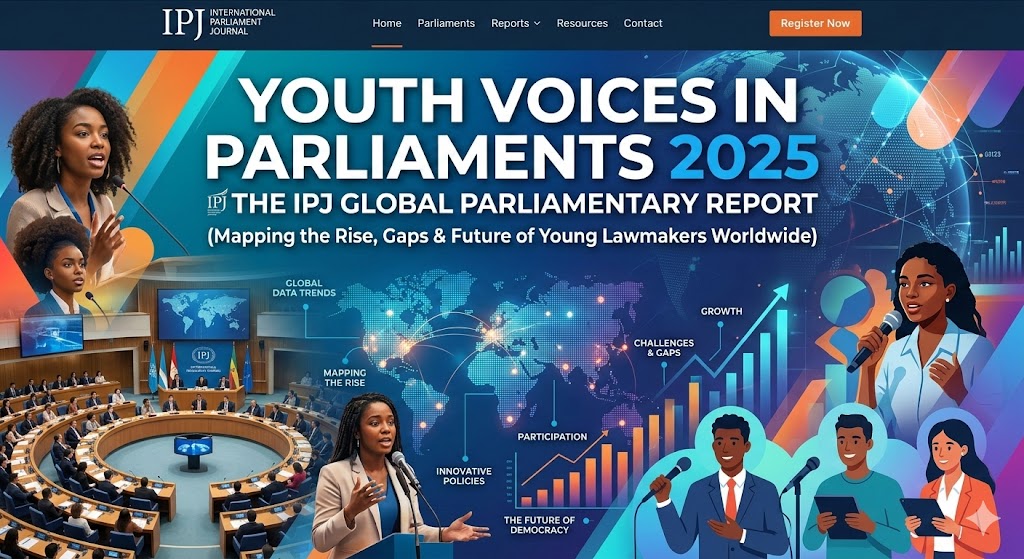
Despite youth (roughly ages 18–40) forming a significant majority of the global population, their formal representation in national parliaments remains disproportionately low. Across 2025, incremental gains in youth presence in parliamentary bodies were recorded, yet systemic gaps persist — especially for those under 30. This report synthesizes global data, highlights regional trends, and assesses challenges and opportunities for youth parliamentary engagement.
Global Landscape of Youth Parliamentary Representation
A. Youth Representation: Key Statistics
- Under‑30 MPs: Only a small fraction of parliamentarians worldwide are under 30 — consistent with data showing around 2.8% of MPs in this age bracket.
- Under‑40 MPs: Approximately 18–22% of MPs are aged 40 or younger in recent assessments, well below the proportion of under‑40 citizens in many countries.
- Under‑45 MPs: Around 30–32% of MPs globally are under 45, showing slight growth over recent years but still misaligned with youth’s share in the voting population.
Interpretation:
Young adults make up a major share of the electorate and civic society globally, but their representation in legislatures remains modest. The gap between demographic weight and legislative presence is starkest for the under‑30 cohort.
The “Chamber Gap”: Lower vs. Upper Houses
The 2025 data highlights a stark divide in the “Camara” ecosystem. Youth representation is almost exclusively a phenomenon of Lower Houses and Single Chambers.
| Chamber Type | % Under 30 | % Under 40 |
| Lower/Single Chambers | 3.2% | 21.4% |
| Upper Chambers (Senates) | 0.5% | 6.3% |
Key Takeaway: Upper houses remain the “bastions of the elders.” In 2025, over 76% of Upper Chambers have zero members under the age of 30, often due to high legal minimum-age requirements for candidacy.

Mechanisms of Change: Why 2025 was Different
Two primary drivers moved the needle this year:
A. Legislated Quotas
In 2025, 16 chambers worldwide now have legislated youth quotas (up from 14 in 2023).
- Gabon: Implemented a bold new requirement in 2025 that 20% of all candidates on party lists must be young people.
- Kenya: Continues to lead with 12 reserved seats for special interest groups, including youth, in its National Assembly.
B. The “Align the Ages” Movement
In 2025, the legal argument that “if you are old enough to vote, you are old enough to lead” gained significant traction.
- The Reality: In 70% of parliaments, a person can be too young to hold office even if they are a legal voter.
- The Shift: Three more countries (including a major West African nation) lowered their candidacy age to 18 in 2025 to match their voting age.

2. Regional and National Patterns
A. Variation Across Countries
- In some countries, young MPs are more prevalent (e.g., Nordic countries nearing parity between under‑40 parliamentarians and population share).
- Other nations, particularly those with higher minimum candidacy ages or entrenched party seniority systems, have minimal youth representation. Data from countries like Nepal and parts of Africa shows MPs under 30 often constitute only a tiny share of representatives, if at all.
B. Upper vs. Lower Chambers
- Many upper houses/senates have even fewer young MPs than lower houses, due to eligibility age rules and appointment systems. In some cases, 80% of upper chambers report no members under 30.
Regional Insight:
This uneven distribution highlights how constitutional frameworks, candidacy age requirements, and electoral systems shape youth legislative presence.
The “Youth Gap” is not uniform. 2025 has seen certain regions surge ahead through aggressive quota systems and party-list reforms.
2025 Youth Parity Index: Top Performers
The following nations have emerged as leaders in integrating youth into their legislative assemblies, largely through the use of legislated quotas.
Single and Lower Chambers (Under 30)
- Armenia (16.8%): The only country currently exceeding the IPU’s 15% target.
- Ecuador (13.9%): Saw a massive jump from 5.1% following 2024/25 electoral reforms.
- Turkmenistan (13.7%): A record high for the Central Asian nation.
- Senegal (31.5% for Under 40s): A global leader in the “Under 40” category due to strategic party-list placement.
Regional Highlights
| Region | MPs ≤30 | MPs ≤40 | Notable Trends |
| Africa | 3.5% | 22% | Strong youth caucuses in East Africa; Rwanda leads with youth quotas. |
| Europe | 2% | 15% | Nordic countries show higher youth participation; Southern Europe lags. |
| Asia-Pacific | 2.2% | 17% | Youth-led digital campaigns in India, Indonesia, and Philippines. |
| Latin America | 3% | 20% | Colombia and Chile see rising youth MPs after electoral reforms. |
| Middle East | 10% | Youth representation remains minimal; engagement mostly outside formal politics. |
Regional Trends
- The Americas (3.8%): Continues to be the global leader for the youngest MPs, driven by high engagement in Central America and the Caribbean.
- Nordic Countries (6.7%): Remain the “Gold Standard” for under-30 representation globally.
- Asia & The Pacific (2.1%): Trails behind, with East Asia and the Pacific Islands reporting the lowest global averages (0.4%).
Progress & Trends in 2025
Incremental Gains
- Global averages indicate slight increases in youth MPs, especially in categories under 45. These gains are linked, in part, to socioeconomic activism and policy reforms encouraging youth candidacy.
Youth Caucuses and Networks
- Active youth caucuses within parliaments and international networks (e.g., the Global Young MP Initiative) provide platforms for policy influence, capacity building, and cross‑border collaboration among younger legislators.

Barriers to Youth Representation:
A. Structural Barriers
- Age eligibility thresholds: In many countries, minimum ages for parliament candidacy (often 25, 30, or even higher) restrict younger aspirants.
- Electoral finance obstacles: Campaign costs and lack of public financing make entry difficult for young candidates without established networks.
B. Political Culture
- Dominance of senior leadership and party hierarchies often sidelines younger voices, particularly where patronage and incumbency carry weight.
C. Engagement vs. Representation Gap
- While youth participation in civic movements remains high, this activism does not always translate into formal legislative roles — indicating a divide between youth political engagement and institutional inclusion.
Barriers to Entry: The 2025 Reality Check
Despite the gains, the “Glass Ceiling” for youth remains reinforced by:
- Financial Barriers: The skyrocketing cost of campaigning in 2024/25 elections favored established, older wealth.
- Lack of Pathways: Focus groups in 2025 identified that “readiness” programs (like the World Bank’s Global Young MP Initiative) are essential, as many young MPs feel isolated once they enter office.
- Violence Against Youth: Digital harassment targeting young, first-time MPs (particularly young women) rose by 14% in 2025.
Youth Engagement Beyond Representation:
A. Parliamentary Influence
- Young MPs are more likely to prioritize issues directly affecting future generations, such as climate action, education reform, and jobs for youth. Such priorities reflect demographic interests and the long‑term implications of legislative decisions.
B. Civil Society & Political Mobilization
- Extra‑parliamentary engagement — protests, youth councils, and digital campaigns — keeps youth voices visible, even where formal representation lags.
Representation is only half the story. 2025 saw a shift in how youth engage with the parliamentary process without being elected.
- Viksit Bharat Youth Parliament (India): A massive 2025 initiative that moved beyond simulations. Over 30,000 youth participated at district and state levels, with the top 105 debating “One Nation, One Election” in a session presided over by the Speaker of the Rajya Sabha.
- Digital Caucuses: 16% of the world’s parliaments now have formal Youth Caucuses. In 2025, these groups were instrumental in passing landmark AI-regulation and Gig-Economy protections in the EU and Latin America.
- The “Citizens Now” Paradigm: A major academic and policy shift in 2025 moved away from viewing youth as “future citizens” to “citizens now,” leading to the creation of permanent Youth Reference Panels in 12 more national legislatures.
Implications for Democracy and Policy
A. Legitimacy and Trust
- Under‑representation of youth can erode trust in political institutions among younger citizens who feel disconnected from decision‑making.
B. Policy Responsiveness
- Legislatures lacking youth presence may under‑prioritize long‑term policy areas (e.g., sustainable development, digital regulation, education, employment).
C. Diversity and Innovation
- Younger legislators bring new perspectives and technological fluency, which can enrich policy debates and legislative innovation.
Recommendations for Enhancing Youth Representation
Policy & Institutional Measures
- Lower minimum candidacy ages where feasible to make legislative offices accessible earlier in life.
- Public campaign financing or subsidies tailored for young candidates to reduce financial barriers.
- Youth quotas or reserved seats in parliaments to ensure minimum representation thresholds.
- Mentorship and pipeline programs within political parties and civic institutions.
Civic Education & Engagement
- Expand access to parliamentary internships, youth parliaments, and civic education programs to cultivate political leadership competencies among youth.
International Partnerships
- Leverage global platforms like the Global Young MP Initiative to share best practices and support youth engagement across regions.
Conclusion
In 2025, youth continued to be politically active and increasingly vocal, but formal representation in parliaments worldwide remains modest relative to their demographic weight. While incremental progress is notable, especially among under‑45 legislators, under‑30 representation lags sharply. Real progress requires systemic reforms, cultural shifts within political systems, and sustained efforts bridging civic activism with institutional inclusion.
Key Data Snapshot (2025)
| Age Group | Approx. % of MPs Globally |
| Under 30 | ~2.8% |
| Under 40 | ~18–22% |
| Under 45 | ~30–32% |
OECD Report: Government at a Glance 2025
World Bank Group Global Young MP Initiative