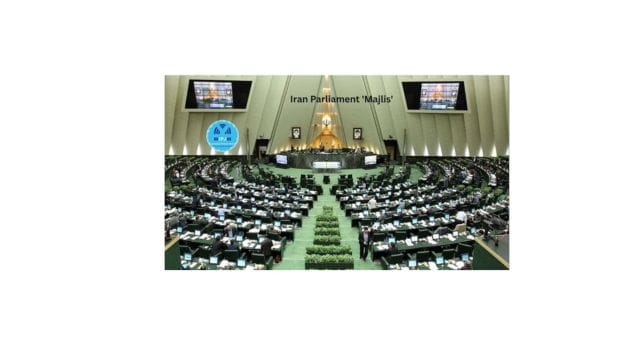
Teharan (IRAN). The Islamic Consultative Assembly of Iran — commonly known as the Majlis — has become one of the most important arenas in the country’s ongoing political, constitutional and geopolitical crisis. While Iran’s real centers of power still lie with the Supreme Leader, the Islamic Revolutionary Guard Corps (IRGC), and unelected oversight institutions, the Majlis in 2026 is playing a highly visible role in legitimizing state policy, managing public anger, and shaping Iran’s position in negotiations with the West.
For The International Parliament Journal (IPJ), the Iranian Parliament offers a rare case study of how legislatures function inside a hybrid ideological state: formally constitutional, electorally managed, yet strategically centralized.
Understanding the Structure of Iran Parliament ‘Majlis’
The Iranian Parliament, or Majlis-e Shoraye Eslami, consists of 290 members elected for four-year terms. Constitutionally, it has authority over:
legislation,
cabinet approvals,
impeachment motions,
budget oversight,
treaties,
and questioning ministers.
However, unlike most democratic legislatures, all major legislation and candidates are filtered through:
the Guardian Council,
the office of the Supreme Leader,
and broader ideological vetting mechanisms.
This creates what many scholars call a “controlled legislature” — one that debates tactics, economics and governance, but rarely challenges the ideological core of the Islamic Republic.
Yet in moments of national crisis, the Majlis becomes politically significant because it:
reflects elite factional struggles,
channels economic dissatisfaction,
provides constitutional legitimacy,
and signals policy direction internationally.
Also Read: Iranian Parliament Votes to Close Strait of Hormuz Amid US Aggression
The Central Figure: Iran Parliament ‘Majlis’ Speaker Mohammad Bagher Ghalibaf

The dominant parliamentary figure in Iran today is Parliament Speaker Mohammad Bagher Ghalibaf.
A former IRGC commander, former Tehran mayor, and longtime conservative power broker, Ghalibaf has emerged as:
a parliamentary strategist,
a national security voice,
and an intermediary between military institutions and civilian governance.
Throughout 2025–2026, Ghalibaf has increasingly positioned the Majlis as the defender of Iran’s sovereignty against Western pressure, especially during negotiations with the United States.
In April 2026, speaking during negotiations in Islamabad, Ghalibaf reportedly said Iran had “goodwill toward negotiations but no trust in the United States.”
That statement reflects the current doctrine inside the Majlis:
negotiations are tactical,
distrust of Washington is structural,
and parliamentary approval is being used as a political shield for national security decisions.
The Nuclear Question Dominates Iran Parliament ‘Majlis’
The single biggest issue before Iran’s Parliament remains:
nuclear sovereignty.
The Majlis has adopted a much harder posture after:
renewed sanctions,
Israeli and American military pressure,
debates over uranium enrichment,
and international scrutiny from the IAEA.
Iranian lawmakers have repeatedly insisted that:
uranium enrichment is a sovereign right,
sanctions relief must precede concessions,
and negotiations cannot occur under military pressure.
A parliamentary statement in 2025 declared:
“Talks cannot be conducted as before.”
The statement further argued that negotiations had been used by the United States “to deceive Iran.”
This language is politically important.
It shows the Majlis is no longer framing diplomacy merely as foreign policy, but as:
a matter of national dignity,
institutional memory,
and regime survival.
Also Read: Iran Parliament Votes to Suspend IAEA Cooperation
Iran Parliament ‘Majlis’ and the Crisis of Legitimacy
Perhaps the biggest internal challenge facing the Majlis is legitimacy.
Iran has experienced:
severe inflation,
currency instability,
youth unemployment,
internet restrictions,
and waves of anti-government protests.
The Parliament has therefore been under immense pressure to demonstrate responsiveness.
One major development occurred in January 2026, when impeachment proceedings against several cabinet ministers were suddenly halted.
According to reports linked to Iran’s Tasnim News Agency, the suspension followed guidance from Supreme Leader Ali Khamenei urging lawmakers to cooperate with the government during unrest.
The halted impeachment motions reportedly targeted ministers responsible for:
labor,
oil,
roads,
agriculture,
culture,
energy,
and sports.
This episode revealed several critical realities about the Iranian Parliament:
1. The Majlis still exercises oversight powers.
Lawmakers were prepared to challenge ministers over economic failures.
2. Supreme authority overrides parliamentary escalation.
Once the Supreme Leader intervened politically, impeachment momentum stopped.
3. Stability currently outweighs accountability.
The state fears institutional fragmentation during economic unrest.
For parliamentary scholars, this is one of the clearest examples of how Iran’s constitutional structure operates in practice:
the legislature functions actively — but ultimately within ideological boundaries set by unelected authority.
Iran Parliament ‘Majlis’ as a National Security Institution

Another major transformation is that the Majlis increasingly acts less like a conventional legislature and more like a strategic security institution.
Speaker Ghalibaf and conservative lawmakers have:
framed economic resistance as national defense,
linked parliamentary decisions to military deterrence,
and justified emergency governance through geopolitical confrontation.
This trend intensified during:
Israel-Iran tensions,
U.S.-Iran negotiations,
Strait of Hormuz disputes,
and debates over sanctions.
In April 2026, Ghalibaf accused the United States and Israel of violating conditions discussed during ceasefire diplomacy.
Iranian parliamentary rhetoric increasingly combines:
constitutional nationalism,
anti-Western resistance,
and wartime political language.
That makes today’s Majlis very different from reform-era Iranian parliaments of the late 1990s and early 2000s.
The Shadow of Succession Politics
Although often discussed quietly, succession politics also loom over the Iranian Parliament.
Following the reported transition after the death of Supreme Leader Ali Khamenei in 2026, Iran’s broader political system entered a sensitive constitutional phase involving the Assembly of Experts and elite power consolidation.
While the Assembly of Experts formally handles Supreme Leader succession, the Parliament remains central because:
it shapes public political messaging,
manages domestic stability,
controls legislative continuity,
and signals elite alignment.
In this environment, parliamentary debates are no longer merely legislative.
They are indicators of factional positioning inside the Islamic Republic itself.
The Core Contradiction of the Iran Parliament ‘Majlis’

The Iranian Parliament today embodies a major contradiction:
It is simultaneously:
powerful and constrained,
elected and filtered,
active and subordinate,
constitutional and ideological.
Unlike ceremonial legislatures, the Majlis genuinely influences:
budgets,
cabinet politics,
economic legislation,
and public discourse.
Yet unlike liberal democratic parliaments, it does not possess ultimate sovereignty over the state.
That sovereignty lies elsewhere:
with the Supreme Leader,
the Guardian Council,
and the broader security establishment.
The result is a legislature that matters deeply —
but within clearly enforced political limits.
Why the Iran Parliament ‘Majlis’ Matters Globally
For international observers, the Majlis is important because it offers insight into:
Iran’s negotiating posture,
internal elite divisions,
sanctions resilience,
and regime stability.
Parliamentary speeches in Tehran often function as:
strategic messaging to Washington,
ideological signaling to domestic audiences,
and bargaining tools in diplomacy.
The Majlis also demonstrates a wider global trend:
legislatures under geopolitical stress becoming instruments of national security politics.
This is visible not only in Iran, but increasingly in:
Israel,
Russia,
Türkiye,
and parts of Asia and Africa.
Iran’s Parliament therefore deserves attention not merely as a domestic institution, but as a case study in how legislatures evolve under:
sanctions,
conflict,
ideological governance,
and contested sovereignty.
For IPJ, this is precisely the kind of parliamentary story that much of the international media overlooks:
not simply “Iran versus the West,”
but the transformation of legislative power inside a revolutionary state.