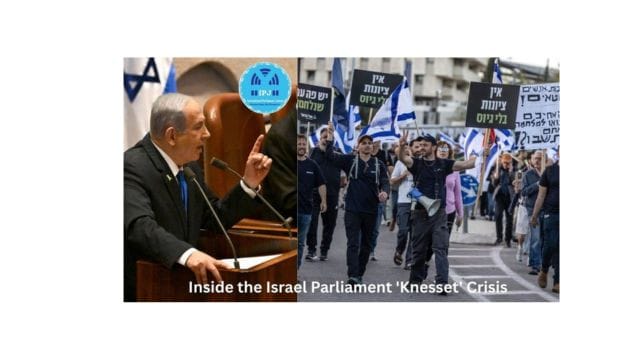
Tel Aviv (ISRAEL): The parliament of Israel — the Knesset — has entered one of the most consequential political crises in recent Israeli history. Prime Minister Benjamin Netanyahu’s coalition is facing possible collapse, lawmakers are advancing legislation to dissolve parliament, and the country is moving toward what could become another historic national election amid war, social division and constitutional strain.
For The International Parliament Journal (IPJ), the Knesset today represents far more than a legislative institution. It has become:
- the battlefield of Israel’s internal ideological war,
- the center of disputes over military service and national identity,
- and the arena where the post-October 7 political order is being contested.
What Is the Israel Parliament ‘Knesset’?
The Knesset is Israel’s unicameral parliament, consisting of 120 members elected through proportional representation.
It is one of the most powerful legislatures in the Middle East because it:
- forms governments,
- can dissolve itself,
- approves military and security budgets,
- oversees cabinet ministries,
- and determines the survival of governing coalitions.
Unlike presidential systems, Israeli politics depends entirely on parliamentary arithmetic.
A prime minister survives only so long as he retains the support of at least 61 lawmakers.
That reality is now threatening Netanyahu’s government.
The Immediate Crisis: Israel Parliament ‘Knesset’ Moving Toward Dissolution
In May 2026, the Knesset advanced a bill to dissolve itself, opening the possibility of snap elections months before the scheduled October 2026 vote. (Reuters)
According to Reuters, lawmakers voted overwhelmingly in a preliminary reading to move the dissolution legislation forward. (Reuters)
If finalized through additional parliamentary readings:
- the government would collapse,
- elections could occur within roughly 90 days,
- and Israel would enter yet another period of political uncertainty. (Al Jazeera)
This is not merely procedural drama.
It reflects a deep structural fracture inside Israeli society and inside Netanyahu’s governing alliance.

The Real Trigger: Ultra-Orthodox Military Conscription
The crisis revolves around one explosive issue:
military service exemptions for ultra-Orthodox (Haredi) Jews.
For decades, many ultra-Orthodox religious students received exemptions from mandatory military service.
But after:
- the Hamas attacks of October 7,
- prolonged military campaigns,
- reserve mobilizations,
- and rising casualties,
public anger intensified over unequal military burdens.
Secular Israelis increasingly argue:
- everyone must serve,
- exemptions are unjust,
- and wartime sacrifice cannot remain unequal.
At the same time, ultra-Orthodox parties insist religious study is central to Jewish identity and state survival.
This conflict has now become existential for Netanyahu’s coalition.
Netanyahu’s Coalition Is Fracturing in Israel Parliament ‘Knesset’?
Netanyahu’s government depends heavily on ultra-Orthodox parties for parliamentary survival.
But those same parties have threatened to bring down the coalition unless legislation protecting draft exemptions is passed. (Anadolu Ajansı)
According to Anadolu Agency, the Degel HaTorah faction warned it would move to dissolve parliament after delays in passing the exemption law. (Anadolu Ajansı)
The Associated Press reported that Netanyahu’s long-standing alliance with religious parties is now threatening his political future rather than protecting it. (AP News)
This is one of the defining contradictions of Israeli politics in 2026:
the coalition that once guaranteed Netanyahu’s dominance is now destabilizing his government.

Why the Draft Crisis Matters Beyond Religion
The conscription dispute is not only about religion.
It touches the deepest questions in Israeli democracy:
- Who carries the burden of war?
- What defines citizenship?
- Can Israel remain both a Jewish state and a liberal democracy?
- How much power should religious parties hold?
- And can wartime governments survive social fragmentation?
The Knesset has effectively become the arena where Israel’s national identity is being renegotiated.
Netanyahu’s Political Survival Strategy
Prime Minister Benjamin Netanyahu is attempting to manage multiple simultaneous crises:
- coalition rebellion,
- public dissatisfaction,
- international criticism over Gaza,
- tensions with Iran,
- domestic protests,
- and ongoing corruption proceedings.
Several reports indicate Netanyahu’s coalition itself submitted dissolution legislation partly to control election timing and prevent the opposition from dictating the process. (Israel & Jewish News – JNS)
This is classic Netanyahu political maneuvering:
if elections become unavoidable, control the parliamentary mechanism before rivals do.
But polls increasingly suggest his coalition may struggle to regain a majority.
The Shadow of October 7 Still Dominates Israel Parliament ‘Knesset’
No discussion of the Knesset in 2026 is possible without understanding the political aftermath of October 7, 2023.
The Hamas attacks fundamentally transformed Israeli politics.
Since then:
- national security dominates parliamentary debate,
- military preparedness has become a political litmus test,
- and coalition legitimacy increasingly depends on wartime leadership.
Chatham House noted that the next Israeli elections may effectively become a referendum on:
“the legacy of 7 October and the future of the social contract.” (Chatham House)
Inside the Knesset, this means every issue —
from budgets to draft exemptions —
is now interpreted through the lens of national survival.

The Rise of Hardline Politics Inside the Israel Parliament ‘Knesset’
Another major transformation is the growing influence of far-right nationalist lawmakers.
Figures such as National Security Minister Itamar Ben-Gvir have become internationally controversial while retaining strong support among parts of Israel’s right wing.
Recent diplomatic backlash erupted after Ben-Gvir circulated footage involving detained Gaza flotilla activists, provoking criticism from multiple governments. (The Guardian)
Prime Minister Netanyahu reportedly distanced himself from the controversy. (The Guardian)
But the episode demonstrated how Knesset politics increasingly affects:
- diplomacy,
- international law debates,
- and Israel’s global image.
The parliament is no longer merely legislating domestic affairs.
It is shaping geopolitical confrontation in real time.

Opposition Politics: Bennett and Lapid Reorganize
The opposition is also repositioning itself.
Former Prime Minister Naftali Bennett and opposition leader Yair Lapid are attempting to rebuild a centrist-national coalition capable of defeating Netanyahu. (The Jerusalem Post)
The emerging opposition message is:
- Netanyahu prolonged division,
- coalition extremism weakened governance,
- and Israel requires institutional restoration after years of polarization.
But Israeli opposition politics remains fragmented.
Even if Netanyahu loses seats, the opposition may still struggle to form a stable parliamentary majority.
That means the Knesset could once again produce:
- deadlock,
- fragile coalitions,
- or repeated elections.
Israel Parliament ‘Knesset’ Under Wartime Pressure
The Knesset today functions under extraordinary security pressure.
Israel remains engaged in:
- the Gaza conflict,
- tensions with Hezbollah,
- confrontation with Iran,
- and broader regional escalation.
Parliamentary debates increasingly merge:
- military strategy,
- emergency governance,
- intelligence policy,
- and constitutional politics.
This wartime atmosphere has strengthened executive power while simultaneously intensifying parliamentary instability.
That contradiction defines Israeli governance in 2026:
the state demands unity,
but politics produces fragmentation.

The Israel Parliament ‘Knesset’ and the Crisis of Democratic Trust
Perhaps the deepest issue confronting Israel’s parliament is institutional trust.
Large sections of Israeli society now distrust:
- political elites,
- coalition bargaining,
- judicial conflicts,
- and parliamentary deal-making.
The earlier judicial reform battles already exposed severe divisions between:
- secular and religious Israelis,
- liberals and nationalists,
- central institutions and populist politics.
Now wartime governance has magnified those tensions.
The Knesset therefore faces not only a coalition crisis —
but a legitimacy crisis.
Why the Israel Parliament ‘Knesset’ Matters Globally
The Knesset matters internationally because Israel sits at the center of:
- Middle East security,
- U.S. regional strategy,
- Iran confrontation,
- and global debates over democracy during conflict.
Parliamentary developments in Jerusalem directly influence:
- military operations,
- ceasefire negotiations,
- regional diplomacy,
- and geopolitical stability.
Israel’s parliament is also increasingly becoming a global case study in:

How democratic legislatures behave under permanent security pressure.
Like many legislatures worldwide, the Knesset is experiencing:
- polarization,
- executive dominance,
- identity politics,
- populist pressure,
- and institutional fatigue.
But in Israel, those pressures unfold under conditions of continuous conflict.
That makes the Knesset one of the most politically consequential parliaments in the world today.
The Central Question Facing Israel Parliament ‘Knesset’
The crisis confronting the Knesset is ultimately larger than Benjamin Netanyahu.
The real question is whether Israel’s parliamentary system can continue balancing:
- religion and democracy,
- security and civil politics,
- coalition bargaining and national unity,
- judicial independence and executive power,
- and ideological identity versus constitutional stability.
The answer to that question will not shape Israel alone.
It will shape the future of parliamentary democracy across an increasingly unstable Middle East.
Ministry of Foreign Affairs Israel
Iran Parliament ‘Majlis’ in 2026: Power, Crisis, and the Politics of Survival
Israel PM Netanyahu Narrowly Survives Knesset Vote as Ultra-Orthodox Draft Crisis Deepens