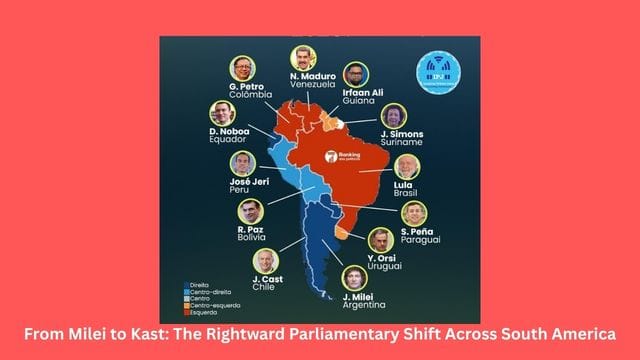
Inputs from IPJ Correspondents from Brasília/Buenos Aires/Bogotá/Caracas/La Paz/Lima/Montevideo/Santiago, (SOUTH AMERICA): A profound ideological shift is reshaping the parliamentary landscape of South America. From the libertarian economic revolution of Argentine President Javier Milei to the hardline conservative ascent of José Antonio Kast in Chile, legislatures across the continent are moving decisively to the right.
The transformation is not merely electoral. It is increasingly parliamentary.
Senates, congresses and national assemblies across South America are becoming the central battlegrounds where competing visions of governance, state power, economic liberalization and public security are colliding. The region’s new conservative and libertarian forces are no longer confined to presidential campaigns; they are now reshaping committee systems, legislative agendas, labour laws, migration frameworks and constitutional debates.
For decades, South America was largely defined by the dominance of left-wing populism, social democratic coalitions and redistributive politics associated with the “Pink Tide.” Today, however, inflation crises, organized crime, migration pressures and public frustration with political elites are accelerating a continental realignment toward conservative parliamentary power.
The result is a new era of legislative confrontation.

| Country | Parliament Type | Right‑leaning Outcome (2025–26) |
|---|---|---|
| Argentina | Chamber of Deputies + Senate | Milei’s LLA gains multi‑decade‑level control in both chambers, enabling veto‑resistant austerity. |
| Chile | Chamber of Deputies + Senate | Right‑centrist plurality in lower house; left‑majority Senate forces compromise. |
| Ecuador | National Assembly | Conservatives gain seats, shifting emphasis to security and fiscal restraint. |
| Honduras | National Congress | Right‑leaning National Party consolidates, aligning with US‑friendly security‑agenda. |
| Bolivia | Pluralization Legislative Assembly | Socialists ousted; new center‑right‑leaning blocs focus on market‑oriented reforms. |
Argentina: Milei’s Parliamentary Revolution
No country illustrates the region’s ideological transformation more dramatically than Argentina.
President Javier Milei entered office as an anti-establishment libertarian outsider promising to dismantle what he called the “political caste.” Two years later, his administration has shifted from rhetorical insurgency to aggressive parliamentary restructuring.
In February 2026, Argentina’s Senate approved sweeping labour reforms backed by Milei’s government, delivering one of the most consequential legislative victories of his presidency. The reforms loosened hiring regulations, reduced employer obligations and curtailed union influence, triggering mass demonstrations outside Congress.
The legislation passed after marathon Senate debates and fierce street mobilizations led by trade unions and Peronist opposition groups. Critics described the reforms as the most radical rollback of labour protections in decades, while the government argued the measures were essential to attracting investment and reviving economic growth.
Milei’s administration is now pushing an even broader legislative agenda involving:
- judicial restructuring,
- privatization,
- electoral reform,
- security legislation,
- deregulation,
- and constitutional changes.
Argentine media reports indicate the government plans to introduce dozens of structural reforms during 2026, fundamentally redesigning the role of the state.
The parliamentary dimension is crucial. Unlike earlier populist leaders who relied heavily on executive decrees, Milei increasingly seeks legitimacy through congressional victories, coalition-building and Senate negotiations. His libertarian movement, La Libertad Avanza, has evolved from a protest force into a legislative machine.
This transformation reflects a broader regional trend: the institutionalization of the new right.
ALSO READ: Argentina Parliament / of the nation (National Congress)
Chile: Kast and the Security Parliament

If Argentina represents the libertarian economic right, Chile symbolizes the rise of security-centered conservatism. The inauguration of José Antonio Kast marked Chile’s sharpest rightward political shift since the return of democracy in 1990.
Kast’s victory was driven by public fears over:
- violent crime,
- illegal migration,
- economic stagnation,
- and institutional instability.
His campaign successfully reframed Chilean politics away from the social justice and constitutional reform debates that had dominated the post-2019 protest era.
Now the struggle has moved into Congress.
Chile’s fragmented legislature is expected to become the principal arena for:
- border security laws,
- anti-crime legislation,
- deportation policies,
- military deployment powers,
- and economic deregulation measures.

Unlike Milei, Kast faces a divided parliament, where conservative forces lack overwhelming dominance. Reuters noted that Chile’s Senate remains deeply fragmented, with swing blocs holding decisive influence over controversial reforms. (Reuters)
Nevertheless, Kast’s rise demonstrates a significant continental pattern: parliamentary conservatism is increasingly built around public security rather than solely economic liberalization.
The “security parliament” is emerging as a defining political model in Latin America.
Also read: Chile Parliament / The National Congress of Chile / Congreso Nacional de Chile
The Collapse of the Pink Tide Consensus
For nearly two decades, South American legislatures were shaped by the ideological legacy of:
- Luiz Inácio Lula da Silva,
- Cristina Fernández de Kirchner,
- Evo Morales,
- and other left-populist leaders.
Parliaments during that era emphasized:
- welfare expansion,
- state intervention,
- labour protections,
- regional integration,
- and constitutional activism.
That consensus has weakened dramatically.
The new parliamentary right is capitalizing on three interconnected crises:
1. Economic Exhaustion
Years of inflation, debt crises and low growth eroded confidence in statist economic models.
Argentina’s economic collapse became the clearest symbol of this fatigue, opening political space for Milei’s radical free-market agenda.
2. Public Security Anxiety
Organized crime, narcotrafficking and migration pressures transformed political priorities across the continent.
Security has become the single most powerful electoral driver in:
- Chile,
- Ecuador,
- Peru,
- Colombia,
- and parts of Brazil.
3. Institutional Distrust
Citizens increasingly distrust traditional parties, legislatures and judicial systems.
This has benefited outsider leaders who portray themselves as anti-establishment reformers fighting entrenched political elites.

Parliament as the New Ideological Battlefield
The new rightward shift is not uniform.
Different countries are producing different forms of parliamentary conservatism.
| Country | Dominant Right-Wing Theme |
|---|---|
| Argentina | Libertarian economic deregulation |
| Chile | Security nationalism |
| Ecuador | Anti-cartel emergency governance |
| Peru | Institutional conservatism |
| Brazil | Market-oriented coalition conservatism |
Yet all share several characteristics:
- skepticism toward expansive state structures,
- emphasis on law and order,
- criticism of progressive identity politics,
- demands for administrative efficiency,
- and growing confrontation with organized labour movements.
This parliamentary shift is also producing a new style of legislative politics:
- highly polarized debates,
- aggressive social media mobilization,
- permanent campaigning,
- and street protests synchronized with parliamentary votes.
In Argentina, labour reform debates unfolded amid violent demonstrations outside Congress. (WTOP News)
In Chile, protests accompanied Kast’s inauguration and continue to shape congressional discourse around migration and policing. (AP News)
Parliamentary institutions are increasingly becoming arenas of cultural confrontation as much as legislative governance.
ALSO READ: ParlAmericas: Colombia: 19th ParlAmericas Plenary Assembly held in Bogota, Colombia
Role of Social Media and Anti-Establishment Politics
A major feature of the new parliamentary right is its digital-native political culture.
Leaders such as:
- Javier Milei,
- José Antonio Kast,
- and Daniel Noboa
have bypassed traditional media structures and cultivated direct online mobilization.
Online communities increasingly frame parliamentary debates in ideological and emotional terms rather than procedural or institutional language.
Reddit discussions around Milei’s labour reforms reflected sharp polarization, with supporters portraying deregulation as essential modernization and critics warning of authoritarian economic restructuring. (Reddit)
This digital ecosystem amplifies parliamentary conflict while weakening traditional consensus-building mechanisms.

A Continental Political Realignment
Analysts increasingly describe South America’s political direction as a regional “rightward correction” following years of dissatisfaction with economic stagnation and governance crises.
Research from S&P Global noted that right-wing and center-right governments are increasingly prioritizing:
- deregulation,
- tax reduction,
- spending cuts,
- investment incentives,
- and security-driven governance. (S&P Global)
The parliamentary implications are enormous.
Legislatures once dominated by debates over redistribution are now prioritizing:
- fiscal austerity,
- border control,
- criminal justice,
- and institutional restructuring.
This transformation may redefine the region’s democratic institutions for the next decade.

The Risks Ahead
The new parliamentary right also faces substantial risks.
Critics warn that:
- hyper-polarization,
- attacks on institutional checks,
- militarized security policies,
- and weakened labour protections
could deepen democratic instability rather than resolve it.
In Chile, opponents fear that hardline security politics could revive authoritarian tendencies associated with the Pinochet era. (AP News)
In Argentina, labour unions accuse Milei’s government of dismantling decades of social protections under the banner of economic modernization. (Al Jazeera)
The tension between reform and institutional stability will likely define South America’s parliamentary politics throughout 2026 and beyond.

Conclusion: South America’s Legislatures Enter a New Era
The ideological center of gravity in South America is shifting.
What began as isolated electoral victories has evolved into a deeper parliamentary transformation driven by:
- economic frustration,
- security anxieties,
- institutional distrust,
- and generational political change.
From Buenos Aires to Valparaíso, legislatures are no longer simply managing governance — they are redefining the political identity of the continent itself.
Whether this rightward parliamentary shift produces democratic renewal or deeper polarization remains uncertain.
What is clear is that South America’s congresses and senates have become the central theaters of one of the most consequential ideological realignments in the democratic world today.
ALSO READ: The Latin American Parliament: An Introduction
Geopolitical Implications and Parliamentary Diplomacy
The systemic shift across South American legislatures has fundamentally reconfigured the region’s foreign policy alignment. For decades, inter-parliamentary bodies like the Mercosur Parliament (Parlasur) and the Andean Parliament focused on deepening regional integration along a center-left axis. Today, these platforms are increasingly used to build sub-continental alliances aligned with Western economic strategies.
The swearing-in of Kast in Chile was attended by prominent conservative leaders from across the hemisphere, highlighting a growing network of inter-parliamentary solidarity. This legislative shift directly impacts global trade dynamics. As the European Union implements its Advanced Framework Agreements with Chile and Mexico, right-of-center parliamentary majorities are prioritizing market access, supply chain security, and critical mineral extraction over supranational environmental regulatory frameworks.
IPJ Editorial Perspective: A New Era of Institutional Governance
For global observers and parliamentary experts, the current transformation of South American governance offers a critical lesson in institutional resilience and adaptation. The rightward shift across the continent is no longer a temporary electoral anomaly; it is a structural reality encoded into the legislative journals, committee reports, and statutory reforms of the region’s assemblies.
As these chambers navigate the delicate balance between executive ambition and legislative oversight, their internal dynamics will shape the economic, social, and geopolitical realities of the Western Hemisphere for the next decade. The era of unchecked executive populism is giving way to a complex, highly polarized period of parliamentary maneuvering—one where the true balance of power is measured vote by vote on the senate floors.
For a broader visual understanding of how political transitions are altering South American governance layouts, watch this detailed report on Argentina’s Budget and Austerity Debates, which highlights the intense legislative friction that set the stage for current parliamentary sessions across the region.
Uruguay Parliament: Lower House Approves Euthanasia Bill, first Latin American country
Venezuela’s parliamentary election & President Nicolás Maduro