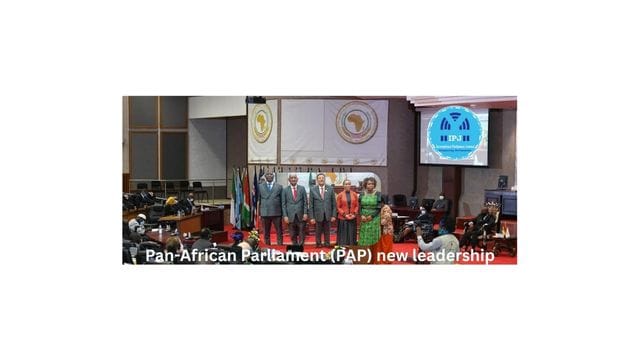
Midrand (South Africa): The 2026 leadership transition at the Pan-African Parliament (PAP) is rapidly emerging as one of the most consequential institutional developments within the African Union system in recent years. Far beyond a routine election of parliamentary office bearers, the contest over the new Bureau has exposed deeper struggles over regional influence, democratic legitimacy, institutional autonomy, and the future trajectory of continental governance in Africa.
Held at the Parliament’s headquarters in Midrand, the Extraordinary Session of the Seventh Legislature convened from April 28 to April 30, 2026, to elect a new President and four Vice-Presidents representing Africa’s five geopolitical regions. The process culminated in the election of Fateh Boutbig of Algeria as President of the PAP, succeeding Fortune Charumbira at a moment when Africa’s continental institutions are confronting rising geopolitical competition, democratic uncertainty, and constitutional pressures.
Pan-African Parliament (PAP) elects its new Bureau:

The newly elected Bureau reflects the African Union’s long-standing principle of equitable regional rotation:
- President (North Africa): Fateh Boutbig – Algeria

- First Vice-President (East Africa): Dr. Ashebir Woldegiorgis Gayo – Ethiopia

Pan-African Parliament (PAP) First Vice-President (East Africa): Dr. Ashebir Woldegiorgis Gayo – Ethiopia The International Parliament Journal IPJ
- Second Vice-President (West Africa): Zanetor Agyeman-Rawlings – Ghana

- Third Vice-President (Central Africa): Djidda Mamar Mahamat – Chad
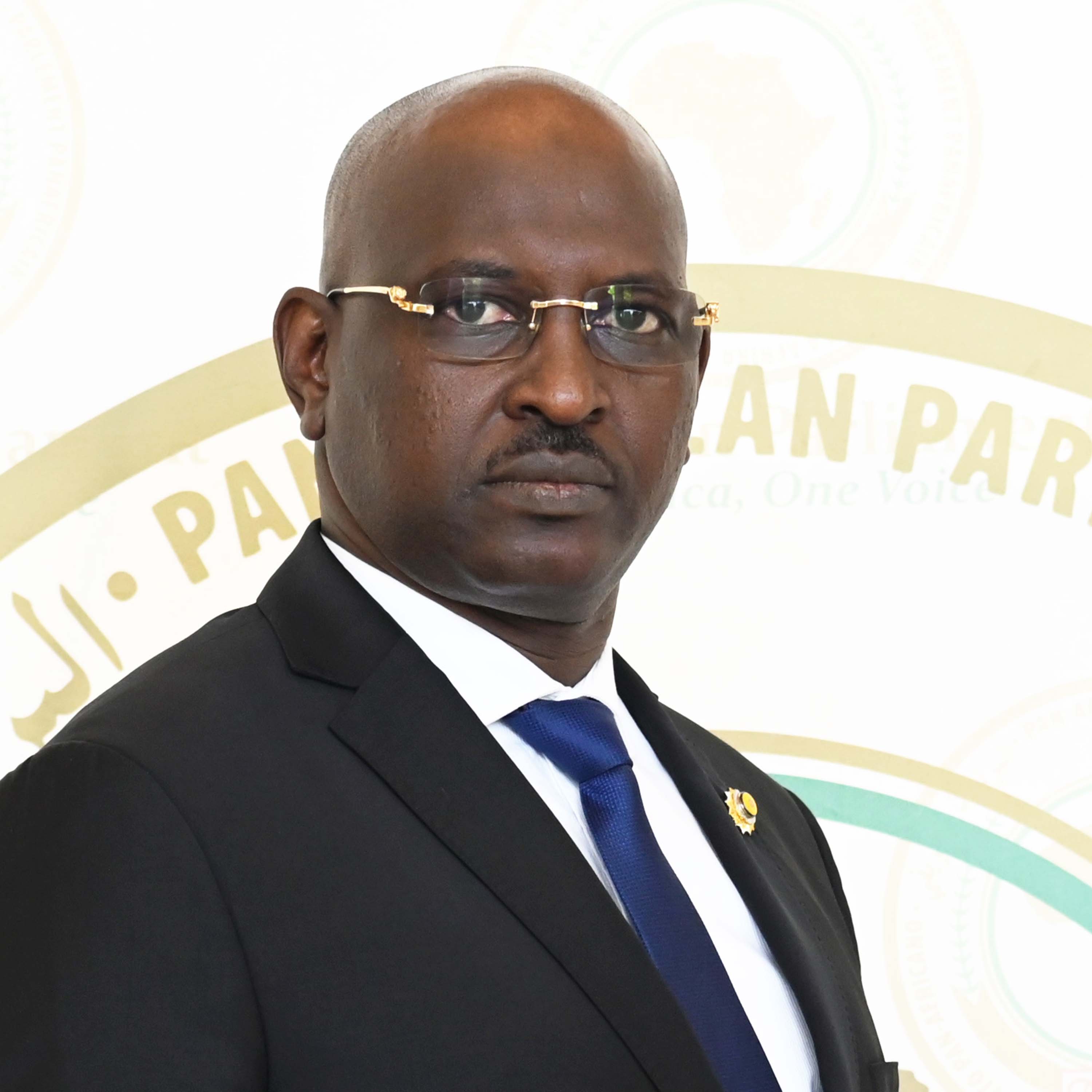

- Fourth Vice-President (Southern Africa): Dr. Arlete Borges – Angola

The elections were conducted under Decisions 1288 (XLVI) and 1663 (XLVII) of the African Union Executive Council and Rule 29 of the PAP Rules of Procedure. The process was overseen by Mahmoud Ali Youssouf and a specially mandated High-Level Group tasked with ensuring transparency, legal compliance, and institutional credibility throughout the electoral exercise.
A Leadership Contest About More Than Leadership
Officially, the transition was designed to maintain institutional continuity inside the Pan-African Parliament. In reality, however, the elections evolved into a broader contest over influence inside Africa’s continental governance architecture.
African diplomats, constitutional scholars, and parliamentary observers increasingly view the PAP as a strategic institution capable of shaping:
- continental democratic norms,
- election observation mechanisms,
- regional integration frameworks,
- migration governance,
- trade harmonisation under the African Continental Free Trade Area,
- and oversight of African Union organs.
As a result, the Bureau transition became a high-stakes diplomatic exercise among Africa’s regional blocs, each seeking stronger representation within the African Union’s evolving institutional structure.
North Africa’s successful acquisition of the presidency is particularly significant. Algeria has intensified its continental diplomatic engagement in recent years amid growing geopolitical competition in the Sahel and broader North African efforts to expand influence within African Union structures. The election of Fateh Boutbig therefore signals more than a parliamentary rotation — it reflects shifting geopolitical balances inside continental diplomacy itself.
ALSO READ: Ethiopia to Host Second African Union (AU) ‘Africa Climate Summit, 2025’
The Longstanding Question: Can the PAP Become Africa’s Legislature?
At the centre of the current debate lies a fundamental institutional question:
Can the Pan-African Parliament evolve from a consultative body into a genuine continental legislature?
Established in 2004 under the Abuja Treaty framework, the PAP was envisioned as a platform to promote African integration, democratic participation, and parliamentary dialogue. Yet despite its symbolic significance, the institution still lacks binding legislative authority comparable to supranational bodies such as the European Parliament.
At present, the Parliament can:
- debate continental governance issues,
- issue policy recommendations,
- encourage harmonisation of national laws,
- and support democratic governance initiatives.
However, it cannot enact binding continental legislation enforceable across African Union member states.
This limitation has increasingly frustrated many African parliamentarians and governance reform advocates who argue that continental integration cannot succeed without stronger democratic institutions capable of exercising legislative oversight across borders.
The 2026 transition has therefore revived demands for:
- ratification of the Malabo Protocol,
- expanded legislative powers for the PAP,
- stronger parliamentary oversight over AU institutions,
- direct representation mechanisms,
- and greater institutional financial autonomy.
Supporters of reform argue that without a stronger parliamentary dimension, continental governance risks remaining overwhelmingly executive-driven and disconnected from ordinary African citizens.

Institutional Reform and Legal Controversy
The transition also exposed important constitutional and procedural tensions within the African Union system.
The African Union Executive Council’s decision to declare all Bureau positions vacant and mandate fresh elections generated intense debate among legal experts and parliamentary observers. Critics argued that excessive involvement by AU executive organs risked undermining PAP institutional autonomy and weakening parliamentary independence.
Several analysts pointed to Article 11(8) of the PAP Protocol, which grants the Parliament authority over its internal procedures and governance mechanisms. Questions emerged over whether executive oversight of the electoral timetable established a precedent for broader external intervention in parliamentary affairs.
The controversy highlighted deeper tensions within continental governance:
- Should African integration remain primarily state-driven through executives and heads of state?
- Or should parliamentary institutions gradually acquire stronger democratic oversight authority?
These debates are likely to intensify in the coming years as continental institutions become increasingly important to Africa’s political and economic future.
Democracy Under Pressure Across Africa
The significance of the PAP transition is amplified by the wider political climate across the continent.
Africa is currently confronting multiple governance and security crises simultaneously:
- military coups in the Sahel,
- constitutional term-extension disputes,
- contested elections,
- shrinking opposition spaces,
- digital surveillance and repression,
- and growing public distrust toward political elites.
Against this backdrop, the Pan-African Parliament is increasingly viewed as a potential democratic stabilising institution capable of strengthening parliamentary diplomacy, supporting constitutionalism, and amplifying citizen participation at continental level.
Yet the institution itself continues to face serious limitations, including:
- weak enforcement authority,
- limited public visibility,
- budgetary dependence,
- and inconsistent political backing from member states.
Whether the new Bureau can address these structural weaknesses will determine the Parliament’s long-term relevance.

Agenda 2063 and the Future of Continental Governance
President Fateh Boutbig has already signalled that the new Bureau intends to align closely with Agenda 2063 — the African Union’s long-term blueprint for continental integration, economic transformation, and democratic consolidation.
Early discussions within the Seventh Legislature have reportedly focused on:
- restructuring permanent committees,
- strengthening governance coordination,
- youth engagement,
- parliamentary harmonisation,
- and institutional reform priorities.
The Parliament has also emphasised its commitment to becoming a more responsive, transparent, and citizen-oriented institution within the African Union architecture.
The Bureau will now oversee the renewal of other major parliamentary structures, including:
- Permanent Committee leaderships,
- regional caucuses,
- thematic caucuses,
- and oversight coordination mechanisms.
These internal reforms will play a major role in determining whether the PAP can transition from symbolic diplomacy into a more operational and influential continental institution.
ALSO READ: Global Parliamentary Year-Ender 2025
Women and Emerging Leadership Dynamics
The election of Zanetor Agyeman-Rawlings as Second Vice-President also reflects the growing prominence of women parliamentarians in continental politics.
Women’s caucuses and youth-oriented parliamentary networks are becoming increasingly influential within the PAP’s internal political dynamics. Observers believe these shifts could gradually influence the institution’s policy agenda toward:
- democratic inclusion,
- governance reform,
- youth participation,
- gender representation,
- and citizen engagement mechanisms.
This evolving leadership profile signals broader generational and political changes inside African parliamentary diplomacy.

Why the PAP Matters to Global Politics
The growing importance of the Pan-African Parliament extends beyond Africa itself.
Global powers including:
- China,
- the European Union,
- Russia,
- India,
- Türkiye,
- Gulf states,
- and the United States
are all deepening engagement with African institutions amid intensifying geopolitical competition across the continent.
As Africa’s demographic and economic significance grows, continental institutions such as the PAP are likely to become increasingly important in shaping:
- trade governance,
- climate negotiations,
- migration policy,
- technology regulation,
- infrastructure coordination,
- democratic norms,
- and continental security frameworks.
A stronger Pan-African Parliament could eventually emerge as a major actor in global governance conversations involving the Global South, multilateral reform, and international development cooperation.
South Africa’s Continuing Strategic Role
The transition also reaffirmed the enduring strategic importance of South Africa as host nation of the Pan-African Parliament headquarters.
Hosting the institution in Midrand provides Pretoria with significant diplomatic visibility and soft power influence inside African governance structures, even as regional leadership competition intensifies among Algeria, Egypt, Kenya, Ethiopia, Nigeria, and Morocco.
The PAP’s presence further reinforces South Africa’s historical positioning as a central hub for continental institutional diplomacy.
A Defining Moment for African Parliamentary Diplomacy
The 2026 leadership transition marks a defining moment for African parliamentary governance.
The new Bureau inherits an institution with considerable symbolic legitimacy but still limited operational authority. Its success will depend on whether it can:
- strengthen institutional credibility,
- expand democratic oversight,
- manage regional rivalries,
- deepen citizen participation,
- and position the Parliament as a serious actor within African governance.
Whether the Pan-African Parliament ultimately evolves into a stronger legislative institution — or remains largely consultative — may shape the future trajectory of African integration itself.
For now, one conclusion is unmistakable:
Africa’s parliamentary politics are no longer peripheral to continental affairs. They are becoming increasingly central to the geopolitical, democratic, and institutional future of the continent.
Pan-African Parliament Hosts 12th Annual Speakers’ Conference