
Narrow Victory Raises Questions About Coalition Stability
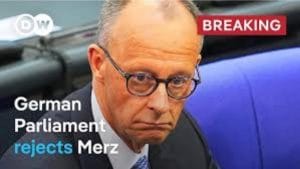
Friedrich Merz has officially been elected Germany’s 10th chancellor since World War II, in Germany Chancellor election, following a tense two-round vote in the Bundestag that exposed cracks in the newly formed ruling coalition. Merz secured 325 votes in the second round—just above the 316 needed for a majority—after 18 coalition members unexpectedly abstained or voted against him in a dramatic first round.
Germany Chancellor election: A Shaky Start for the Conservative-Social Democrat Alliance
The initial failure to win the chancellorship outright stunned observers and signaled potential instability in the CDU/CSU-SPD coalition. Merz’s centre-right CDU/CSU bloc underperformed in February’s snap election with 28.6%, while the SPD recorded its worst result in over a century with just over 16%. Together, their narrow majority leaves the government vulnerable to internal dissent.
Germany Chancellor election: AfD Emerges as Strongest Opposition Force
The far-right Alternative für Deutschland (AfD) party, now the largest opposition bloc, was quick to seize on the coalition’s struggles. AfD co-leader Alice Weidel mocked Merz’s initial failure on social media, calling it proof of the coalition’s weak foundation. The AfD, recently labeled a “confirmed right wing extremist” group by German intelligence, is gaining ground amid growing public discontent.
Challenges Ahead: Economy, NATO, Ukraine, and Unity
Merz assumes office facing a daunting policy agenda. The German economy remains stalled, and fears are rising about Donald Trump’s potential return to the U.S. presidency disrupting NATO and transatlantic unity. Germany, the second-largest military donor to Ukraine after the U.S., is under pressure to maintain strong support for Kyiv.
Ukrainian President Volodymyr Zelenskyy congratulated Merz, calling for strengthened German leadership in Europe at a time of deep uncertainty.
Fiscal Reform Sparks Backlash Within CDU
Even before taking office, Merz pushed through a controversial reform of Germany’s constitutional “debt brake,” freeing up funds for military and infrastructure investment. While seen as bold by some, the move angered fiscal conservatives within his own party, potentially contributing to Tuesday’s dissent in parliament.
Public Scepticism Undermines Merz’s Mandate
Despite his victory, Merz remains deeply unpopular with much of the electorate. A recent ZDF poll found that only 38% of Germans supported him as chancellor, and 62% of SPD voters outright rejected him. The coalition itself has stronger backing than its leader, with 48% support, but many Germans doubt its ability to solve the country’s pressing problems.
A Symbolic Return to Europe and NATO Leadership
Merz’s first foreign visits as chancellor will take him to Paris and Warsaw, signaling a renewed German engagement with the EU. He will then mark the 80th anniversary of the end of WWII in Berlin, followed by a visit to Brussels for meetings with EU and NATO officials.
European Commission President Ursula von der Leyen, a CDU ally, welcomed Merz’s election, calling him “a proven friend and expert on Europe.”
Political Infighting Could Empower the Far Right
Political analysts warn that unless the CDU/SPD coalition can maintain internal discipline, Germany risks further political instability. “Mistrust could spread in both parliamentary groups,” said political scientist Ursula Münch, potentially weakening Merz’s ability to govern and handing an advantage to the AfD.
A Chancellor Decades in the Making
Merz, 69, a corporate lawyer and longtime CDU heavyweight, has long aspired to be chancellor. After being sidelined during Angela Merkel’s tenure, he shifted the party rightward upon becoming CDU leader in 2022, particularly on immigration and security. But this pivot may not be enough to halt the AfD’s rise, or to reassure a public increasingly uneasy with Germany’s political direction.
Singapore PM Lawrence Wong Leads Singapore’s Ruling Party, PAP to Landslide Election Victory
https://parliamentjournal.com/2025/05/08/europe-george-simion-wins-first-round-of-romanias-presidential-rerun/