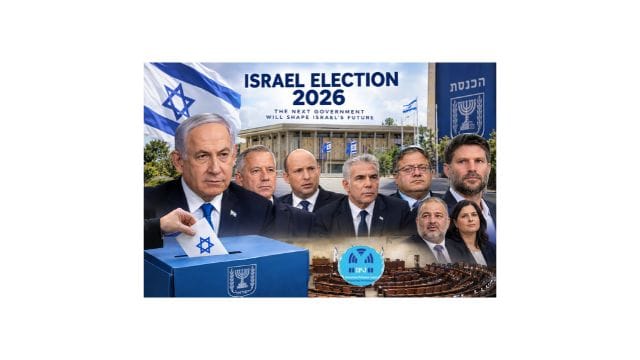
IPJ Special Report:
Israel is approaching a pivotal parliamentary election on 27 October 2026. Prime Minister Benjamin Netanyahu’s political future, the composition of the next government and the direction of Israeli domestic and foreign policy are all at stake.
The election is taking place against the background of the Hamas-led attacks of 7 October 2023, the subsequent wars, continuing security concerns, controversy over government accountability, disputes over military-service exemptions and deep divisions over the relationship between Israel’s political institutions.
Netanyahu’s Likud party faces a significant challenge from centrist opposition leader Gadi Eisenkot and his Yashar! party. Former prime minister Naftali Bennett and opposition leader Yair Lapid are also important figures in the contest. Meanwhile, far-right parties and ultra-Orthodox political factions remain influential because Israel’s proportional electoral system makes coalition formation essential.
Arab-led parties could become decisive if neither major political camp wins enough seats to form a government. However, political disagreements over security, the Palestinian question and participation in government could complicate negotiations.
The central question is therefore not simply which party will win the most votes. It is whether either political camp can assemble a workable parliamentary majority of at least 61 members in the 120-seat Knesset.
IPJ assessment: The election represents a test of political accountability, coalition governance, minority representation and Israel’s capacity to balance security priorities with economic stability and democratic institutional credibility.

The Election at a Glance
| Indicator | Position |
|---|---|
| Election date | 27 October 2026 |
| Legislature being elected | 26th Knesset |
| Total parliamentary seats | 120 |
| Seats required for a majority | 61 |
| Electoral threshold | 3.25% of valid votes |
| Incumbent prime minister | Benjamin Netanyahu |
| Principal opposition contender | Gadi Eisenkot |
| Other major political figure | Naftali Bennett |
| Potential coalition kingmakers | Arab-led parties and smaller political factions |
Israel’s election date and parliamentary arrangements are confirmed by the official election timetable. The Israel Democracy Institute also provides a dedicated 2026 election timeline. The final allocation of seats will depend on votes cast, the electoral threshold and the official count.
Why This Election Matters
The election is widely viewed as a referendum on Netanyahu’s leadership, particularly his government’s handling of the 7 October 2023 attacks and the conflicts that followed.
For Netanyahu, the campaign is an opportunity to argue that his security policies and military strategy have strengthened Israel’s position. His opponents, however, are seeking to make government accountability, public confidence and the consequences of the wars central electoral issues.
The result could influence five major areas:
- National security: Israel’s approach to Gaza, Iran, Hezbollah and other regional threats.
- Government accountability: Whether the next government establishes an official commission of inquiry into the failures surrounding 7 October.
- Democratic institutions: The balance of power between the government, parliament and judiciary.
- Social cohesion: Military-service obligations, ultra-Orthodox exemptions, Arab citizens’ representation and relations between different communities.
- Economic policy: Defence expenditure, public debt, the cost of living, taxation, employment and investment.
Consequently, the election will have implications beyond the identity of the next prime minister. It could determine the policy priorities and institutional direction of the next Israeli government.

Benjamin Netanyahu and Likud: Can the Incumbent Retain Power?
Benjamin Netanyahu, Israel’s longest-serving prime minister, heads Likud, the country’s major right-wing party.
His political strategy centres on security, national strength and continuity. Netanyahu can point to Israel’s military capabilities and the resilience of parts of the economy as arguments in favour of retaining his leadership.
Nevertheless, his government faces questions over the security failures of October 2023, the duration and consequences of subsequent conflicts, and the need for an independent investigation into the events surrounding the attacks.
The prime minister must also manage tensions within his own political camp. Far-right and ultra-Orthodox parties have played important roles in sustaining his governing coalition. Their demands can affect policy on settlements, religious affairs, public expenditure and military-service exemptions.
Likud’s challenge is therefore twofold: it must secure sufficient parliamentary representation while retaining the support of smaller parties whose cooperation may be necessary to form the next government.
Netanyahu has also indicated that an electoral setback would not automatically end his political career. His future will depend not only on Likud’s performance but also on the availability of coalition partners.
Read Also: Egypt Parliamentary Elections 2025: What you should know
Gadi Eisenkot and Yashar!: The Main Challenge to Netanyahu
Gadi Eisenkot, a former Israel Defense Forces chief of staff, has emerged as a leading challenger through his centrist Yashar! party.
His military background gives him credibility among voters who prioritise national security. At the same time, his campaign has placed emphasis on domestic governance, the cost of living, education, equal military service and an official inquiry into the failures of 7 October.
Eisenkot’s appeal rests partly on the argument that Israel needs a change in political leadership without abandoning its security priorities.
However, his path to the premiership is not straightforward. A party can win the largest number of seats and still fail to form a government. Eisenkot must assemble a coalition that can command sufficient support in the Knesset.
His position on cooperation with Arab-led parties presents an additional obstacle. Such parties could supply crucial parliamentary support, but Eisenkot has publicly rejected aligning with them, citing significant ideological differences.
This creates a strategic dilemma: he must appeal to voters seeking a change of government while maintaining a viable route to a parliamentary majority.
Read Also: Syria Parliament Election: Date sets for First Parliamentary Elections After Assad’s Fall
Naftali Bennett, Yair Lapid and the Wider Opposition
Naftali Bennett and Yair Lapid remain important figures in the broader opposition landscape. Their political cooperation under the Beyachad banner provides an additional centre-right and centrist alternative to Likud.
Bennett’s religiously observant but socially liberal political identity may appeal to voters who support a strong security policy but are dissatisfied with Netanyahu’s leadership and dependence on far-right or ultra-Orthodox factions.
Lapid, meanwhile, represents a secular centrist constituency and has experience leading a previous Israeli government.
The broader opposition faces a coordination problem. Its constituent parties do not necessarily share the same positions on religion and state, Palestinian statehood, West Bank settlements, military strategy or relations with Arab parties.
Their ability to cooperate after election day may therefore prove just as important as their individual electoral performances.
The decisive question is whether opposition leaders can negotiate a common governing programme and distribute ministerial responsibilities without allowing ideological differences to undermine the coalition.

The Far Right and Ultra-Orthodox Parties
Far-right and ultra-Orthodox parties remain important to the election because they can influence the balance of power in a fragmented parliament.
Otzma Yehudit
Led by Itamar Ben-Gvir, Otzma Yehudit advocates a hard-line nationalist and security agenda. Its electoral performance will matter both for the party’s own representation and for Netanyahu’s potential coalition options.
Religious Zionist Party
Led by Bezalel Smotrich, the Religious Zionist Party supports an assertive security policy and the expansion of Israeli settlements. Its positions on the occupied West Bank could complicate relations with Palestinians and affect Israel’s international standing.
Shas and United Torah Judaism
These ultra-Orthodox parties prioritise religious education, community interests, social funding and arrangements governing religious life.
Military-service exemptions for ultra-Orthodox men have become a major point of contention. The issue connects questions of religious freedom and community autonomy with the distribution of national obligations during a prolonged period of security mobilisation.
These parties can exercise disproportionate influence when larger parties fall short of a majority. Their demands may determine the composition of the cabinet, budget priorities and legislative agenda.
Arab Citizens and the Coalition Equation
Arab citizens account for approximately one-fifth of Israel’s population. Their turnout and parliamentary representation could prove decisive in a closely contested election.
The United Arab List, known as Ra’am and led by Mansour Abbas, has sought to demonstrate that Arab-led parties can influence government policy through parliamentary participation. In 2021, Ra’am became the first independent Arab-led party to join an Israeli governing coalition.
The Joint List, comprising Hadash, Ta’al and Balad, represents a different political approach and has opposed Israel’s occupation of the West Bank and the war in Gaza.
Arab-led parties have raised concerns over crime, discrimination, public services, community safety and the future of Palestinian-Israeli relations. Their leaders are also seeking greater influence over the formation of the next government.
The challenge is that some Jewish-led opposition parties have resisted formal alliances with Arab parties. This reluctance could prevent an anti-Netanyahu bloc from reaching the 61-seat majority even if its combined representation exceeds that of Netanyahu’s immediate allies.
Arab parties may therefore choose between joining a coalition, supporting a minority government from outside or remaining in opposition while negotiating specific legislative concessions.
Their influence will depend on turnout, the number of seats they secure and the willingness of other parties to negotiate.
Israel’s Electoral System: Why 61 Seats Matter
Israel uses a nationwide proportional-representation system to elect the Knesset.
Voters choose party lists rather than directly electing a prime minister. Parties receive seats broadly in proportion to their share of valid votes, subject to the electoral threshold and the applicable allocation rules.
A party must receive at least 3.25% of the valid vote to enter the Knesset. The parliament has 120 members, making 61 seats the threshold for a majority.
After the election, the process of forming a government begins. The president consults representatives of the elected party lists and assigns a member of the Knesset the task of forming a government. That person must secure the support needed to establish a government under Israeli law.
This system has three important consequences.
First, the party that wins the most seats is not automatically guaranteed the premiership.
Second, smaller parties can become pivotal coalition partners.
Third, a fragmented result can produce prolonged negotiations or political deadlock.
Israel’s experience with repeated elections between 2019 and 2022 demonstrates how difficult it can be to assemble a durable governing majority when political blocs are closely balanced.
Security, Gaza and the October 7 Inquiry
Security is likely to remain one of the election’s defining issues.
The Hamas-led attacks of 7 October 2023 exposed major failures in Israel’s security preparedness. The subsequent war in Gaza and wider regional confrontations have intensified debate over military strategy, the protection of civilians, the return of hostages and the future governance of Gaza.
Netanyahu’s supporters may argue that military action and a hard-line security posture are necessary to deter Israel’s adversaries. Critics argue that military operations alone cannot resolve the wider political and security challenges.
The demand for an official commission of inquiry is particularly significant. Such an inquiry could examine intelligence assessments, military readiness, political decision-making and the allocation of responsibility before and during the attacks.
Eisenkot and some Arab-led political figures have supported an inquiry. Its establishment could become an important condition in negotiations over parliamentary support.
The next government will also face decisions concerning Iran, Hezbollah, the security of Israel’s northern border and the relationship between military objectives and diplomatic initiatives.
These issues are likely to shape Israel’s relations with the United States, European governments and regional partners.
The Economy: Defence Spending, Debt and the Cost of Living
Economic resilience is another major theme.
Reuters reported on 20 October 2026 that Israel’s economy grew by more than the 1.8% average recorded across OECD economies in 2025. However, the country has also experienced higher defence expenditure, a larger fiscal deficit and rising public debt.
The high-tech sector remains central to the economy. It accounted for more than half of Israel’s exports and approximately 18% of GDP in 2025, according to the Reuters analysis.
This strength does not eliminate underlying vulnerabilities. A concentrated tax base, skilled-worker emigration, investment uncertainty and the economic costs of prolonged conflict could complicate future growth.
The next government will face difficult choices involving:
- Defence budgets and long-term public finances.
- Taxation, productivity and employment.
- Housing and the cost of living.
- Research, innovation and foreign investment.
- Public expenditure on education, health and infrastructure.
- Greater participation in employment and military service across population groups.
The ultra-Orthodox community’s labour-market participation and military-service arrangements are particularly important to the debate over long-term fiscal sustainability.
For investors and international businesses, the election will be relevant not only because of immediate market reactions but also because it may influence fiscal policy, judicial institutions, regulatory predictability and Israel’s ability to attract global capital.
Democracy, the Judiciary and Institutional Accountability
The relationship between the executive, parliament and judiciary remains a central constitutional issue.
The government’s judicial changes have generated significant public controversy. Supporters argue that elected officials should have greater influence over judicial appointments and that courts have accumulated excessive power. Opponents warn that weakening judicial checks could undermine institutional independence and the separation of powers.
These disagreements intersect with broader questions of political accountability and public confidence.
The next Knesset will have an important role in determining whether the country moves towards compromise over judicial reform or continues a period of institutional confrontation.
For parliamentary observers, the key indicators will include the legislative agenda, the independence of oversight mechanisms, committee scrutiny, the treatment of opposition parties and the willingness of the governing coalition to investigate government failures.
A stable majority alone will not resolve these questions. Institutional legitimacy will also depend on transparency, accountability and the protection of democratic procedures.

Foreign Policy and Parliamentary Diplomacy
Israel’s election has implications for regional diplomacy and its international relationships.
Relations with the United States will remain central to security cooperation, military assistance, diplomacy over Iran and efforts to manage the wider Middle East conflict.
Relations with European governments could also be affected by the next government’s approach to Gaza, settlements, humanitarian concerns and the prospects for a political settlement with the Palestinians.
At the regional level, the future of normalisation and cooperation with Arab states will depend on security calculations as well as the Palestinian question.
Parliamentary diplomacy can provide channels for dialogue even when executive-level relations are strained. Legislatures, foreign-affairs committees and parliamentary friendship groups can support exchanges on conflict prevention, humanitarian access, trade, technology, climate resilience and institutional cooperation.
For the Knesset, international engagement will therefore be influenced by both the composition of the next coalition and its policy choices.
Possible Post-Election Scenarios
Scenario A: Netanyahu forms another coalition
If Likud and its right-wing and ultra-Orthodox partners can secure sufficient support, Netanyahu could remain prime minister. Such an outcome would likely preserve much of the existing coalition’s approach to security and settlement policy, although negotiations with smaller parties could shape the programme.
Scenario B: Eisenkot leads a change of government
If Yashar! and allied parties secure enough parliamentary support, Eisenkot could lead a new government. However, coalition negotiations would require compromises among parties with differing ideological priorities.
Scenario C: Arab parties become decisive
If neither major camp reaches 61 seats, Ra’am and the Joint List could become important in negotiations. Their influence could take the form of formal coalition participation, external support for a minority government or issue-specific parliamentary agreements.
Scenario D: Coalition deadlock
If party leaders cannot bridge their differences, Israel could face prolonged negotiations and the possibility of another election. Under the relevant legal arrangements, the outgoing government would continue in a caretaker capacity until a successor government could be formed.
These scenarios are analytical possibilities, not predictions of the final result.
14. What International Observers Should Watch
In the final days of the campaign and during the formation of the next government, five indicators deserve particular attention:
- Turnout: Especially among Arab citizens and other groups whose participation could alter the distribution of seats.
- Threshold risks: Parties polling near 3.25% may determine whether votes translate into parliamentary representation.
- Coalition commitments: Public red lines on Arab-party cooperation, military-service exemptions and judicial reform may narrow the options available after the vote.
- Economic priorities: The proposed balance between defence spending, debt, public services and productivity will affect the country’s medium-term outlook.
- Institutional accountability: The future of the October 7 inquiry and judicial reform will signal how the new government approaches checks and balances.
Polling and seat projections should be treated as snapshots of voter intentions rather than confirmed outcomes. The official result and subsequent coalition negotiations will determine the actual distribution of political power.
Conclusion: More Than a Contest for the Premiership
Israel’s 27 October election is a consequential test of leadership, security policy and parliamentary coalition-building.
Netanyahu retains a political base and can argue that his government has pursued a determined response to regional threats. Nevertheless, the questions surrounding the October 2023 attacks, the cost of prolonged conflict and domestic institutional divisions have created a serious challenge.
Eisenkot offers an alternative centred on leadership change, security credentials and domestic governance. Yet his ability to translate electoral support into a government will depend on cooperation among parties whose positions differ sharply on key questions.
Arab-led parties could become pivotal, highlighting the influence of minority representation in a proportional parliamentary system. At the same time, disagreements over coalition participation reveal the limits of that influence.
Ultimately, the election will be decided not only at the ballot box but also through the negotiations that follow it. The next government’s capacity to establish a durable majority, address public accountability and manage Israel’s security and economic challenges will shape the country’s domestic and international trajectory.
For the International Parliament Journal, the election offers a significant case study in coalition democracy, parliamentary representation and the relationship between national security and institutional accountability.
Israel Parliament Knesset
gov.il – services and government information website