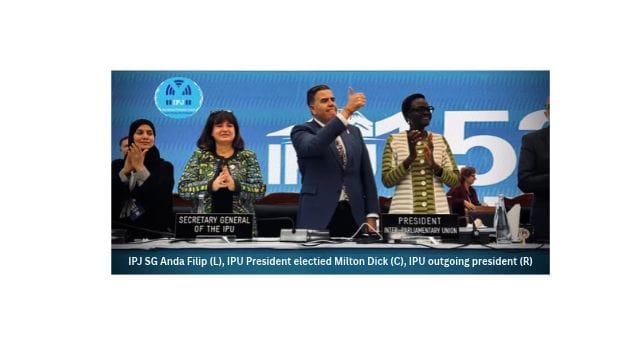
Arusha, (United Republic of Tanzania). Australia’s House of Representatives Speaker, Milton Dick, has been elected the 32nd President of the Inter-Parliamentary Union (IPU). He secured 56% of the vote in a secret ballot at the organisation’s 153rd Assembly in Arusha, Tanzania, on 9 October 2026. He succeeds Tanzania’s Dr Tulia Ackson, whose three-year term ended with the Assembly. The election places an Australian parliamentary leader at the head of one of the world’s oldest international political organisations.
Who Is Milton Dick?
Milton Dick is an Australian Labor Party politician who represents the federal electorate of Oxley in Queensland. He has served in Australia’s House of Representatives since 2016. Before entering federal Parliament, he served on Brisbane City Council from 2008 to 2016.
Dick studied at the University of Queensland. He later worked as an adviser in the Australian federal government and in local government. His experience combines electoral politics, public administration and parliamentary leadership.
He was elected Speaker of Australia’s House of Representatives on 26 July 2022. He was re-elected unopposed on 22 July 2025. As Speaker, he has emphasised impartiality, inclusion and engagement. He has also supported efforts to make Parliament a safer and more respectful workplace.
His election as IPU President adds an international dimension to his parliamentary responsibilities. It also builds on his existing involvement in parliamentary diplomacy and inter-parliamentary cooperation.

Milton Dick’s election as IPU President: Key facts
- Name: Milton Dick
- Nationality: Australian
- Political party: Australian Labor Party
- Current national office: Speaker of the House of Representatives of Australia
- New international office: 32nd President of the Inter-Parliamentary Union
- Election date: 9 October 2026
- Election venue: Arusha, United Republic of Tanzania
- Voting result: 56% in one round of secret-ballot voting
- Predecessor: Dr Tulia Ackson of Tanzania
- Term: Three years
- Other candidates: Sahiba Gafarova of Azerbaijan and Rojo Edwards Silva of Chile
The official IPU announcement confirms that Dick won the election after one round of voting. The other candidates were Sahiba Gafarova, Speaker of Azerbaijan’s Milli Majlis, and Chilean senator Rojo Edwards Silva.

What Is the Inter-Parliamentary Union?
The Inter-Parliamentary Union is the global organisation of national parliaments. It was founded in 1889 to promote cooperation and dialogue among nations through their elected representatives.
The IPU works to strengthen parliamentary democracy. Its priorities include peace, human rights, sustainable development, gender equality and more inclusive political representation. It also provides a forum in which parliamentarians can discuss international challenges and build cooperation across political and national boundaries.
Following the affiliation of the Parliament of Naoero, the organisation has 184 national Member Parliaments and 15 regional parliamentary bodies. Its reach gives the IPU a significant role in connecting legislators from different political systems and regions.
The organisation is not a world legislature. It does not replace national parliaments or make domestic laws for its members. Instead, it supports dialogue, cooperation and parliamentary action on issues that cross national borders.
What Does the IPU President Do?
The IPU President serves as the organisation’s political head. The President chairs statutory meetings and represents the IPU at major international events. The role also involves guiding parliamentary dialogue and supporting the organisation’s wider objectives.
The President is elected for a three-year term. The office-holder must remain a sitting member of Parliament throughout the mandate.
Dick’s new position will require engagement with parliamentary leaders, national delegations and international institutions. It will also require him to work closely with the IPU Secretariat and its Secretary General, Anda Filip, who was elected in April 2026.
The President’s influence depends on the ability to build consensus among member parliaments. The role is particularly important when governments disagree or diplomatic relations are strained. Parliamentary channels can provide space for dialogue even when executive-level engagement is difficult.

Milton Dick’s priorities: Dialogue, inclusion and parliamentary diplomacy
Dick has highlighted dialogue, respect and cooperation as essential principles of parliamentary work. Speaking after his election, he said:
“Today, there are no winners or losers. The IPU has spoken with one voice. This is democracy.”
He also emphasised the importance of listening to one another and seeking common ground. His remarks set a clear tone for his presidency: parliamentary cooperation should continue even when political differences remain.
Before his election, Dick served as Vice-President of the IPU Executive Committee, representing the Asia-Pacific Group. He also chaired the organisation’s Sub-Committee on Finance. These responsibilities gave him experience of the IPU’s internal governance and financial oversight.
In Australia, he has promoted Parliamentary Friendship Groups and engagement with the diplomatic community. These activities are relevant to the IPU presidency because they connect national legislatures with international partners.
His leadership will be judged by how effectively these principles are translated into practical cooperation. Parliamentary dialogue must produce opportunities for members to exchange information, address shared concerns and maintain communication during periods of conflict.
What Does His Election Mean for Australia?
Dick’s election gives Australia a prominent position in international parliamentary diplomacy. It creates an opportunity for Australian parliamentary experience to contribute to discussions involving democracy, governance, human rights and international cooperation.
The election also reflects the international character of the IPU. Its leadership is chosen by representatives of member parliaments, rather than by a single national government.
For Australia, the presidency offers a platform to strengthen parliamentary relationships across regions. The Asia-Pacific dimension is especially relevant, given the diversity of political systems, development priorities and security concerns across the region.
However, the office is international in scope. Dick will be expected to represent the IPU as a whole, rather than advance only Australian interests. His success will depend on his ability to engage with parliaments across different regions and political traditions.

The 153rd IPU Assembly: Global lawmakers seek common ground
Dick was elected during the 153rd IPU Assembly, held in Arusha from 5 to 9 October 2026. Nearly 700 parliamentarians from more than 130 countries attended. The participants included 50 Speakers and 45 Deputy Speakers of parliaments.
Women accounted for 39.4% of participating lawmakers. According to the IPU, this was a record share for an IPU Assembly.
The gathering took place against a backdrop of armed conflicts, geopolitical tensions and pressure on democratic institutions. Delegations were given a platform to discuss these challenges and seek common ground through parliamentary engagement.
The Assembly’s general debate focused on “Enhancing good governance and empowering communities through inclusivity, trust and opportunities for all.”
The theme placed public needs at the centre of parliamentary work. It also highlighted the relationship between inclusive governance, public trust and equal opportunities.
The Assembly brought together the IPU’s statutory bodies, including its four Standing Committees, the Forums of Women and Young Parliamentarians, the Committee on Middle East Questions and the Task Force for the peaceful resolution of the war in Ukraine.
Arusha Communiqué: Putting people at the centre of governance
The Arusha Communiqué called for parliamentary work to reflect the realities of the people represented by elected lawmakers.
It stressed that good governance should be measured by its impact on people’s lives. Equal opportunities, accessible public institutions and evidence-based decision-making were identified as important elements.
The communiqué also called for laws, policies and budgets to be informed by reliable evidence. This includes official statistics, scientific and quantitative data, community knowledge and people’s lived experiences.
Parliamentarians were encouraged to remain accessible to their constituents, particularly people living in remote areas and communities affected by crises.
For Dick, the communiqué provides a framework for his presidency. Its emphasis on trust and inclusion aligns with the principles he highlighted after his election.
The challenge will be to encourage national parliaments to turn these commitments into measurable improvements in legislative scrutiny, public participation and government accountability.

Disability inclusion and parliamentary representation
The Assembly adopted a resolution on “Inclusive social development for all: Parliamentary strategies to promote the rights and empowerment of persons with disabilities.”
The resolution treats disability inclusion as a matter of human rights, democratic representation and sustainable development. It calls for national legislation to be aligned with the United Nations Convention on the Rights of Persons with Disabilities.
It also emphasises dedicated resources and meaningful participation by persons with disabilities in decision-making. The principle of “nothing about us, without us” underlines the importance of including people directly affected by public policy.
The resolution provides a practical test for parliaments. Legislative commitments must be supported by appropriate budgets, effective oversight and opportunities for people with disabilities to influence decisions that affect their lives.
Climate resilience becomes a parliamentary priority
Climate-related disasters also featured prominently on the 153rd IPU Assembly’s agenda. Nepal submitted an emergency-item request urging parliaments to take urgent action on climate-related disasters and strengthen resilience across the Himalayan region and other vulnerable areas.
The request highlighted the growing climate risks facing vulnerable communities. It followed deadly flash floods and landslides in Nepal in August 2026, which caused widespread devastation.
Climate disasters often cross national borders and demand international cooperation. Parliaments can help communities prepare for these emergencies by strengthening disaster-management laws, increasing investment in resilient infrastructure and holding governments accountable for climate adaptation programmes.
The IPU can help national parliaments coordinate their responses, share effective policies and strengthen cooperation among climate-vulnerable countries. Lawmakers can also scrutinise public spending, monitor adaptation projects and advance climate justice to protect communities from escalating climate risks.
Parliamentary diplomacy amid global conflicts
The 153rd Assembly also provided a forum for delegations from countries affected by conflict. Parliamentary dialogue can be particularly valuable when diplomatic relations between governments are strained.
The IPU’s work includes discussions on the peaceful resolution of conflicts, human rights and the protection of civilians. During the Assembly, parliamentary bodies also addressed international security and the future of multilateral cooperation.
Other subjects included the military applications of artificial intelligence, oversight of extractive industries, mental health, AI and children’s rights, the future of work, food systems, mountain and ocean ecosystems, reform of the United Nations Charter and maritime security.
These issues demonstrate the expanding scope of parliamentary diplomacy. Legislatures increasingly need to examine the legal, economic and social consequences of technological change, conflict and environmental risk.
Dick’s presidency will provide an opportunity to reinforce the role of parliamentarians in these discussions. The task will be to maintain dialogue while respecting the diversity of member parliaments and their national responsibilities.
Human rights of parliamentarians
The IPU also works to protect parliamentarians whose human rights are under threat. Through its Committee on the Human Rights of Parliamentarians, the organisation examines cases involving lawmakers who face threats, restrictions, intimidation or other forms of danger.
At the 153rd Assembly, the committee adopted decisions on cases involving parliamentarians from Argentina, Colombia, the Democratic Republic of the Congo, Eritrea, Myanmar, Tunisia and Türkiye. These decisions highlight the IPU’s continued efforts to defend elected representatives and uphold their fundamental rights.
Furthermore, protecting parliamentarians remains essential to strengthening democracy. When authorities threaten lawmakers or prevent them from performing their duties, they undermine parliamentary independence and weaken democratic institutions. Consequently, safeguarding elected representatives also helps parliaments hold governments accountable and represent citizens effectively.
The issue also raises broader concerns about political freedom, due process and the independence of legislative institutions. Therefore, as the IPU enters a new chapter under its incoming leadership, continued action to protect parliamentarians and defend their rights will remain central to its mission of promoting democracy, human rights and international parliamentary cooperation.

The challenges ahead for the new IPU President
Dick begins his three-year term at a time when international cooperation faces significant pressure. Armed conflicts, geopolitical rivalry, climate emergencies and rapid technological change are testing established institutions.
His principal challenge will be to turn the IPU’s commitments into practical parliamentary cooperation. This will require sustained engagement with national Speakers, parliamentary committees and individual lawmakers.
Three priorities stand out.
First, maintaining dialogue across political divides. The IPU brings together parliaments with different political systems and foreign-policy positions. Its effectiveness depends on keeping channels of communication open.
Second, strengthening inclusive governance. The Arusha Communiqué places public trust, participation and equal opportunities at the centre of parliamentary work. Progress will require parliaments to scrutinise laws and budgets and involve communities in decision-making.
Third, demonstrating practical results. Resolutions and declarations establish shared principles, but their value depends on implementation. Parliamentary oversight, information-sharing and follow-up will be needed to assess progress.
Dick’s experience as Speaker and his previous involvement in the IPU’s Executive Committee may help him navigate these responsibilities. His presidency will ultimately be assessed by the extent to which the organisation can strengthen cooperation among member parliaments.
What happens next?
The 154th IPU Assembly will take place in Geneva, Switzerland, from 17 to 21 May 2027. During the Assembly, parliamentarians will discuss shared challenges, exchange policy ideas and, most importantly, strengthen international parliamentary cooperation. <Link url=”https://www.ipu.org/about-ipu/structure-and-governance/assemblies” title=””/>
Meanwhile, Milton Dick’s election marks a new chapter for the Inter-Parliamentary Union (IPU). As the organisation’s new President, he has an opportunity to strengthen parliamentary diplomacy. Furthermore, he can help build bridges between legislatures at a time when political divisions and international tensions continue to challenge global cooperation.
Following his election, Dick emphasised the importance of dialogue, respect and cooperation. Therefore, he will need to translate these principles into practical action by bringing lawmakers together, encouraging constructive debate and helping parliaments find common ground. Above all, his leadership will face its greatest test when political differences prove difficult to overcome.
At the same time, the IPU must continue supporting national parliaments as they work to promote peace, democracy, human rights and sustainable development. To achieve these goals, Dick can use his three-year term to encourage inclusive governance, deepen international dialogue and promote practical cooperation among parliaments. Ultimately, the success of his presidency will depend on how effectively he turns the promise of parliamentary diplomacy into meaningful progress.
About the IPU: Founded in 1889, the Inter-Parliamentary Union is the global organisation of national parliaments. It promotes parliamentary cooperation, peace, democracy, human rights and sustainable development. It currently comprises 184 national Member Parliaments and 15 regional parliamentary bodies.
Sources: 153rd IPU Assembly to convene in the United Republic of Tanzania on 5-9 October 2026