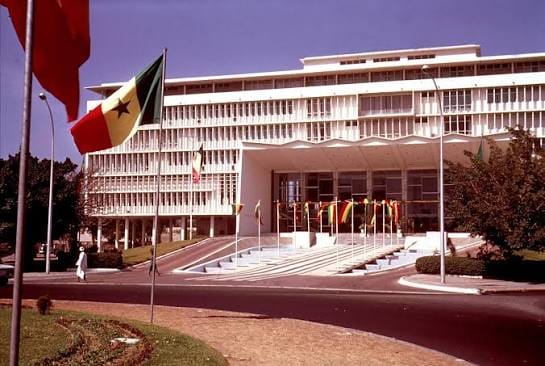
By IPJ West Africa Desk | Dakar, Senegal — November 23, 2026
A high-stakes constitutional and fiscal standoff has gripped Dakar after Senegal’s National Assembly overwhelmingly voted down the government’s 2027 draft budget, prompting President Bassirou Diomaye Faye to bypass lawmakers by enacting a previously rejected 2026 budget revision via presidential decree.
The legislative rebellion—driven by an internal rupture between President Faye and National Assembly Speaker Ousmane Sonko, leader of the ruling PASTEF party—places legislative control over public finances at the center of Senegal’s economic survival. At stake is a proposed $2.2 billion International Monetary Fund (IMF) financing programme critical to stabilizing a public-sector debt burden estimated at 132 percent of GDP.
Back-to-Back Parliamentary Rejections
On November 18, deputies in the 165-seat National Assembly voted 126 to 18 to reject the opening revenue-and-balance section of the 2027 Finance Bill, halting parliamentary debate on the remainder of the spending package.
The vote followed an earlier legislative defeat on November 3, when lawmakers threw out Bill No. 40/2026—an amended 2026 Finance Act that cut projected revenues by CFA 340.1 billion ($582.6 million), lowered real GDP growth estimates from roughly 5 percent to 2.7 percent, and widened the fiscal deficit from 5.4 percent to 7.6 percent of GDP.
| Fiscal / Legislative Measure | Key Dates & Figures | Parliamentary & Executive Outcome |
| Revised 2026 Finance Act (Bill No. 40/2026) | Deficit raised to 7.6% of GDP; energy subsidies set at CFA 790.3bn | Rejected by Parliament on Nov. 3; enacted by Presidential Decree on Nov. 19 |
| 2027 Draft Finance Bill (Part I) | Filed Oct. 12; voted on Nov. 18 | Rejected 126–18 by the National Assembly |
| Proposed IMF Support Programme | $2.2 billion staff-level deal reached in Sept. 2026 | IMF Executive Board approval stalled pending an agreed budget framework |
| Constitutional Window | 60-day legislative review limit from Oct. 12 filing | Expires mid-December; executive may invoke decree powers again if deadlocked |
(Sources: National Assembly of Senegal, Ministry of Finance and Budget, IMF)
READ Also: Africa: Who was Malawi’s Vice President Dr. Saulos Klaus Chilima, Died in an unfortunate plane crash

IMF Negotiations Caught in Political Crossfire
Senegal’s previous IMF arrangement was suspended in 2024 after the incoming administration uncovered widespread under-reporting of public debt and deficit figures by the prior government. While Finance Minister Cheikh Diba secured a staff-level agreement in September 2026 for a new $2.2 billion programme, the IMF has maintained that formal Executive Board approval requires a credibly enacted national budget framework.
Inside the National Assembly, PASTEF deputies aligned with Speaker Sonko argued that the 2027 budget projections lacked credibility because they relied on the unapproved 2026 fiscal baseline. More fundamentally, Sonko and his parliamentary bloc have publicly opposed debt-restructuring conditions tied to the IMF bailout, framing external fiscal dictates as an infringement on national sovereignty.
“The decision was taken as the guardian of the constitution and guarantor of the regular functioning of the state.”
— Office of the President of the Republic of Senegal, Statement on Enacting the 2026 Revised Budget by Decree (November 19, 2026)
Finance Minister Diba warned that prolonged legislative gridlock threatens to delay social protection transfers, public infrastructure projects, and sovereign bond confidence across the West African Economic and Monetary Union (WAEMU) debt market.
READ Also: Pan-African Parliament Hosts 12th Annual Speakers’ Conference
Legislative Control vs. Executive Decree Powers
The crisis highlights a classic constitutional tension in semi-presidential systems: the balance between parliament’s foundational “power of the purse” and executive emergency mechanisms designed to prevent government shutdowns.
Under Senegal’s constitution and organic budget law, the National Assembly holds 60 days from a finance bill’s submission—October 12 in the case of the 2027 budget—to approve, amend, or reject fiscal legislation. If lawmakers fail to adopt a budget within that constitutional window, the President is empowered to bring the financial provisions into force by ordinance or decree.
By invoking decree authority on November 19 to enforce the revised 2026 accounts, President Faye resolved immediate year-end accounting requirements. However, legal and parliamentary scholars in Dakar note that governing through executive fiscal decrees undermines democratic accountability and signals institutional instability to international creditors.
Outlook for Dakar’s Legislature
With the 60-day clock ticking toward mid-December on the 2027 Finance Bill—and following PASTEF’s expulsion of 32 dissenting party members on November 17—Dakar faces three potential paths forward:
Negotiated Budget Revision: The Ministry of Finance submits an amended 2027 finance text incorporating parliamentary demands on subsidy protections and debt transparency.
Repeated Executive Decree: If parliament maintains its blockade past the December constitutional deadline, President Faye enforces the 2027 budget by decree.
Snap Parliamentary Dissolution: With constitutional restrictions on dissolving the Assembly lifting in early December, the standoff could culminate in early legislative elections in the first quarter of 2027.
For a visual overview of how the standoff developed, watch Senegal president bypasses parliament to advance $2.2 billion IMF bailout, which outlines the debt pressures and executive decree behind the dispute.
What to watch
- IMF board: whether the decree-backed 2026 budget satisfies the Fund, or whether the 2027 bill must also pass.
- Dissolution: AFP reports that the head of state can dissolve the Assembly from 2 December and call early legislative elections within 90 days. archyde
- Cash flow: the ministry has warned that prolonged uncertainty could tighten government cash flows and potentially touch priority spending.
IPJ will continue to follow developments in the National Assembly of Senegal.