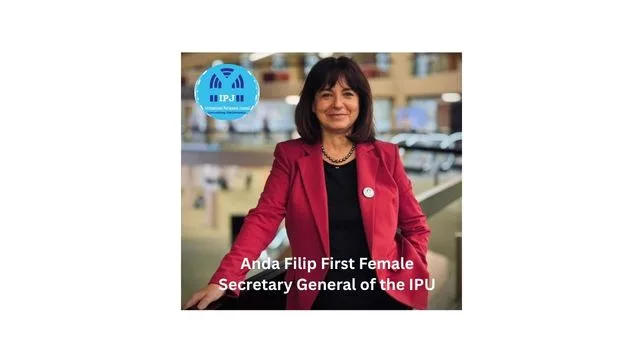
GENEVA/ISTANBUL, September 9, 2026: Anda Filip has made history as the first woman and first Eastern European to serve as Secretary General of the Inter-Parliamentary Union (IPU), bringing more than two decades of experience in parliamentary diplomacy, international affairs and multilateral cooperation to the leadership of the world’s oldest international parliamentary organisation.
Filip was elected Secretary General at the 152nd IPU Assembly in Istanbul, Türkiye, in April 2026, securing 72% of the vote in a single round. She formally took office on 1 July 2026, succeeding Cameroonian diplomat Martin Chungong, who completed three terms after serving as Secretary General since 2014.
Her election represents a landmark moment for an organisation founded in 1889, more than a century before the current global system of parliamentary diplomacy took shape.
The IPU describes itself as the global organisation of national parliaments and currently brings together 183 Member Parliaments and 15 regional parliamentary bodies. Its work focuses on parliamentary dialogue, peace, democracy, human rights, sustainable development and stronger, more representative parliaments.
A historic first for the IPU
Filip’s election is significant on several levels.
She is not only the first woman to become IPU Secretary General, but also the first Eastern European to occupy the position.
The IPU has existed for 137 years, having been founded in 1889. Until Filip’s election, the organisation’s Secretariat had never been headed by a woman.
The appointment places the IPU among a growing number of major international institutions that have appointed women to their highest executive positions.
For an organisation whose central mission includes strengthening democratic institutions and advancing gender equality in political life, Filip’s appointment carries particular institutional significance.
Her election also reflects the changing geographical character of the IPU, which has evolved from its European origins into a genuinely global parliamentary organisation.

Elected with 72% of the vote
The election took place during a session of the IPU Governing Council in Istanbul on 19 April 2026.
Four candidates ultimately contested the position: Cecilia Widegren of Sweden, Anda Filip of Romania, Dionysia-Theodora Avgerinopoulou of Greece and Fatou Dieng Thiam of Senegal.
Filip won the election in a single round, receiving 72% of the vote.
According to the IPU, 321 parliamentarians from 126 countries participated in the secret ballot. The voting system also reflects the organisation’s commitment to gender-balanced parliamentary representation: Member Parliaments with gender-balanced delegations can exercise three votes, while single-sex delegations have one vote. All Member Parliaments have the same voting weight regardless of their size.
Following her election, Filip said she was deeply humbled by the confidence and support of the membership and pledged to work in the service of countries and their parliaments.
Also read: Inter Parliamentary Union (IPU)
Who is Anda Filip?
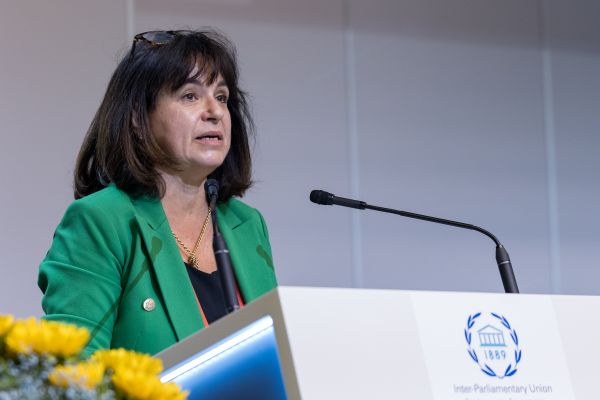
Anda Filip is a Romanian diplomat and international parliamentary affairs specialist whose career has been closely connected with both diplomacy and the IPU.
She joined the IPU in 2003 and has spent more than 20 years working within the organisation.
Before becoming Secretary General, she served as Director for Member Parliaments and External Relations, a position she held from 2011.
The role placed her at the centre of the IPU’s engagement with national parliaments and external partners and gave her extensive experience in parliamentary diplomacy and multilateral relations.
Her career within the IPU also includes an important period at the United Nations.
From 2003 to 2011, Filip served as the IPU’s Permanent Observer to the United Nations in New York, where she worked to strengthen the parliamentary dimension of global governance.
Her experience therefore spans two complementary areas: traditional diplomacy between governments and parliamentary diplomacy involving elected legislatures.
Experience in Romanian diplomacy
Before taking up senior positions at the IPU, Filip worked as a diplomat in the Romanian Ministry of Foreign Affairs.
Her diplomatic career included senior assignments involving international organisations and bilateral relations.
She served as:
- Ambassador and Permanent Representative to the international organisations based in Geneva;
- Minister Counsellor at the Romanian Embassy in Washington, D.C.; and
- Spokesperson for Romania’s Ministry of Foreign Affairs.
This background gives Filip experience across diplomatic missions, international organisations, government communication and multilateral negotiations.
Her subsequent transition into parliamentary diplomacy at the IPU added another dimension to her international career.
More than two decades inside the IPU
Filip’s long association with the IPU is also unusual for a Secretary General.
The organisation says she has served as Secretary of 25 IPU Assemblies, giving her extensive practical knowledge of how the organisation’s principal parliamentary gatherings function.
She has also served as Secretary of the IPU’s Standing Committee on Peace and International Security and Standing Committee on United Nations Affairs.
This experience has placed her close to the substantive political work of the organisation, including issues involving peace and security, international cooperation and the relationship between parliaments and the United Nations.
As a result, Filip assumes the Secretary General’s position with a detailed understanding of the organisation’s membership, governing structures and parliamentary diplomacy mechanisms.

What does the IPU Secretary General do?
The Secretary General is the chief executive of the IPU.
The position is different from that of the IPU President.
The President provides political leadership to the organisation, while the Secretary General is responsible for managing the Secretariat and ensuring that decisions taken by the IPU’s membership and governing bodies are implemented.
The Secretary General works with the President and under the supervision of the IPU’s governing structures to help define and implement the organisation’s strategic direction.
The Secretary General is also responsible for facilitating the political work of the organisation, supporting Member Parliaments and governing bodies, mobilising resources and representing the IPU at major international conferences.
The position therefore combines executive management, international diplomacy, parliamentary engagement and institutional representation.
A four-year mandate
Filip’s initial term runs from 1 July 2026 to 30 June 2030.
The IPU Secretary General is elected by secret ballot by the Governing Council from a shortlist recommended by the Executive Committee.
The mandate is initially four years and can be renewed.
Her tenure begins at an important moment for the organisation as the IPU prepares to implement its 2027–2031 Strategy.
The new strategy places emphasis on strengthening parliamentary capacity, supporting democracy, improving accountability and helping parliaments respond to emerging challenges, including artificial intelligence and technological change.
From Martin Chungong to Anda Filip
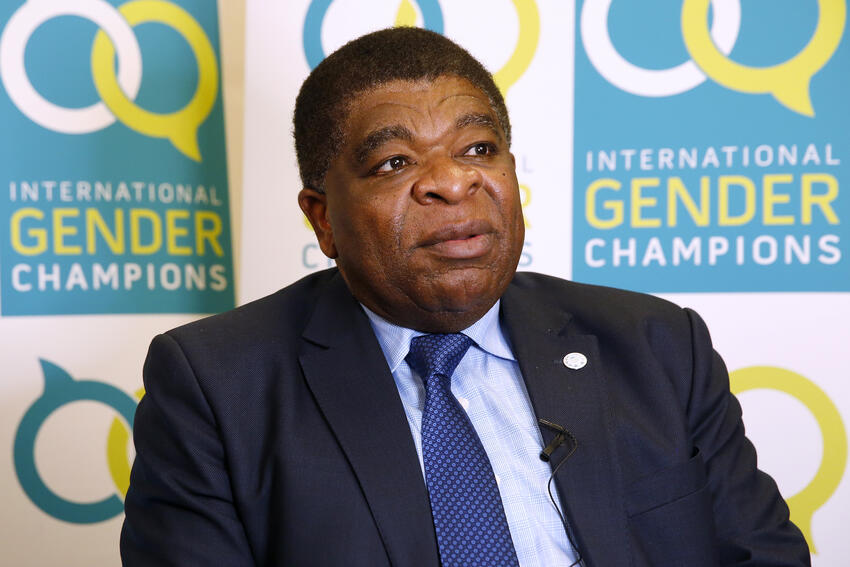
Filip succeeds Martin Chungong of Cameroon, who served as Secretary General from 2014 to 2026.
Chungong made history when he became the IPU’s first African and first non-European Secretary General in 2014.
During his three terms, he focused on democracy, parliamentary development, gender equality, youth participation and strengthening the IPU’s global reach.
Filip’s appointment consequently represents another important stage in the geographical evolution of the organisation.
The transition moves the IPU leadership from Africa to Eastern Europe, while continuing a broader trend of the organisation reflecting its increasingly diverse global membership.
A long history of influential Secretaries General
The office has a long institutional history.
The first IPU Secretary General was Marquis de Pandolfi of Italy, appointed in 1891.
He was followed by Albert Gobat of Switzerland, who served from 1892 to 1909 and was awarded the Nobel Peace Prize in 1902.
Norwegian peace advocate Christian Lange, who served from 1909 to 1933, received the Nobel Peace Prize in 1921.
Other long-serving Secretaries General included Léopold Boissier of Switzerland, André de Blonay of Switzerland, Pio-Carlo Terenzio of Italy, Pierre Cornillon of France and Anders B. Johnsson of Sweden.
Martin Chungong served from 2014 until 2026.
Filip is the 10th Secretary General in the IPU’s institutional history.
The longevity of several previous Secretaries General has provided continuity to an organisation that has experienced two world wars, the Cold War, decolonisation, the expansion of parliamentary democracy and the emergence of today’s increasingly complex geopolitical environment.
Filip’s early months: from election to action
Filip’s new leadership is already reflected in the IPU’s international programme.
In August 2026, she signed a cooperation agreement in Beijing with Liu Qi, Secretary General of the Standing Committee of China’s National People’s Congress. The agreement aims to strengthen cooperation on parliamentary action towards the Sustainable Development Goals.
China will provide a five-year voluntary contribution of US$1.5 million. The funds will support IPU programmes and events. They will focus particularly on capacity-building for parliamentarians in developing countries.
In early September, Filip also led an IPU mission to Bangladesh. The mission focused on parliamentary reform.
It examined potential technical support for Bangladesh’s Parliament. It also discussed youth participation and support for women parliamentarians.
The delegation further explored ways to improve parliamentary administrative, technical and research services.
These engagements offer an early indication of Filip’s responsibilities as Secretary General. Her role includes strengthening parliaments and facilitating dialogue. It also involves building cooperation across different political systems.
A leadership role at a difficult moment for parliaments
Filip takes office at a challenging time for parliaments around the world.
Parliamentary institutions face growing political, technological and institutional pressures.
Armed conflicts are affecting international relations and parliamentary diplomacy. Democratic backsliding is creating additional challenges. Misinformation and political polarisation are also putting pressure on democratic institutions.
Climate change adds another major challenge. The rapid development of artificial intelligence is creating new questions for parliaments and policymakers.
The IPU’s 152nd Assembly in Istanbul highlighted the scale of these challenges. The Assembly brought together more than 1,500 delegates. They included more than 720 parliamentarians from 126 countries.
The Assembly adopted the Istanbul Declaration. It reaffirmed commitments to peace, human rights and United Nations principles.
The declaration also addressed geopolitical tensions and democratic challenges. Inequality, climate change and disruptive technologies were among the other issues discussed.
Filip must therefore balance institutional continuity with adaptation. The IPU needs to respond to a rapidly changing international environment.
Her leadership will be important in shaping how the organisation supports parliaments during this period of uncertainty.
Why Anda Filip’s appointment matters
For the IPU, Filip’s appointment is about more than gender representation.
Her career embodies the evolution of parliamentary diplomacy itself.
She has worked within a national foreign ministry, represented Romania at international organisations, served the IPU at the United Nations, worked directly with national parliaments and managed external relations for the organisation.
That combination gives her experience across the three levels that increasingly define international parliamentary diplomacy: national legislatures, international organisations and diplomatic institutions.
Her election also sends a symbolic message to national parliaments around the world.
The organisation responsible for bringing together the world’s parliaments is now headed, for the first time, by a woman.
The road ahead
As the IPU’s first woman and first Eastern European Secretary General, Anda Filip begins her four-year mandate with a substantial institutional inheritance. She also takes charge with an ambitious strategic agenda.
Her immediate challenge will be to turn the IPU’s new strategy into practical support for its 183 Member Parliaments. At the same time, she will need to preserve the organisation’s role as a platform for dialogue across political and geopolitical divides.
Filip brings a broad range of experience to the position. Her diplomatic background gives her an understanding of international relations. Her long career within the IPU gives her deep knowledge of parliamentary diplomacy. Her experience with national parliaments adds another important dimension to her leadership.
The significance of her appointment will ultimately go beyond its historic nature. Her leadership will be judged by how effectively she uses the IPU’s unique position. The organisation has an important role in strengthening parliamentary diplomacy, democratic institutions and cooperation among parliaments.
That role is becoming increasingly important at a time of profound global uncertainty.
For the International Parliament Journal (IPJ), Filip’s election marks a new chapter in the history of parliamentary diplomacy. A Romanian diplomat, international parliamentary affairs expert and longtime IPU official now leads the world’s global organisation of national parliaments.
Who will be the IPU’s next Secretary General? know the candidates